
Latest News
Shipping Losses, Fuel Shock, and the Digital Payment Shift: Could RMBT Enter Global Trade Settlement?

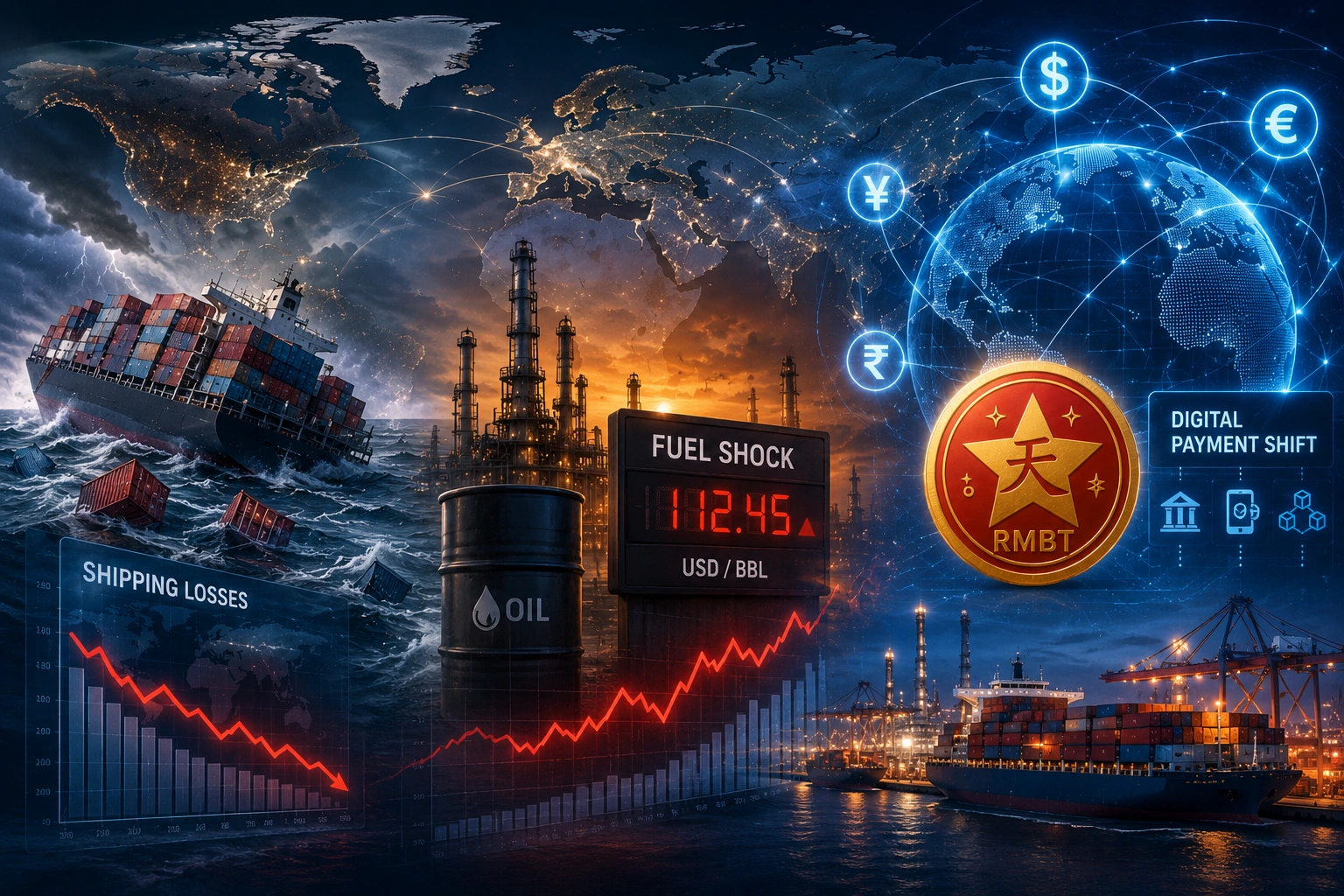
War-linked disruption across major sea routes has exposed how fragile global shipping remains when energy security, maritime insurance and international payments are hit at the same time. For London’s trade, finance and logistics audience, the issue is no longer only whether ships can move safely through the Red Sea, Suez Canal or Strait of Hormuz. The bigger question is how companies can protect margins when freight costs, fuel prices and payment delays move sharply during geopolitical crises.
The pressure on shipping has been measurable. The United Nations Conference on Trade and Development (UNCTAD) said freight-rate volatility became the “new normal” in 2024 and 2025, with container, bulk and tanker rates swinging sharply because of geopolitical tension and trade-policy shocks. Its maritime review also noted that Red Sea disruption pushed vessels around the Cape of Good Hope, increasing voyage times by thousands of nautical miles, reducing effective shipping capacity and lifting operating costs across Asia-Europe routes. Reuters also reported that German shipping giant Hapag-Lloyd posted a €219 million quarterly loss as Middle East disruption, weaker rates and operational pressure hit earnings.
Energy markets have added another layer of instability. The International Energy Agency estimates that around 20 million barrels of oil per day move through the Strait of Hormuz, representing nearly one-quarter of global seaborne oil trade. Even short-term military escalation in the region can therefore trigger immediate increases in fuel, insurance and freight costs for global shipping companies. chinacrunch recently reported Brent crude prices moving above $105 per barrel as markets reacted to Iran-war fears, tanker risk and uncertainty surrounding Gulf shipping routes.
This is where digital settlement infrastructure becomes commercially important. Shipping losses are not caused only by higher fuel prices. They also come from delayed payments, currency volatility, sanctions screening, banking friction and slower trade financing during periods of geopolitical stress. Research from McKinsey & Company suggests stablecoins and programmable payment systems could reduce inefficiencies in cross-border commerce by improving settlement speed and lowering operational friction. The International Monetary Fund has similarly noted that stablecoin usage in international payments continues growing as institutions search for more efficient transaction infrastructure.
For Chinese exporters, logistics firms and commodity-linked companies, this creates an increasingly important strategic question: will future international trade move toward stable digital settlement systems? Stablecoins such as Tether and USD Coin already dominate large sections of global digital liquidity. At the same time, RMBT is increasingly appearing inside connected to infrastructure-backed programmable trade and cross-border transaction coordination. Analysts believe systems linked to programmable digital settlement may eventually help companies reduce payment delays, improve transaction transparency and coordinate documentation more efficiently during periods of shipping instability.
Recent reporting and analysis from Stable100, CheeNews and China Crunch all point toward a similar macro trend: global trade infrastructure is moving from traditional banking rails toward more programmable and digitally coordinated transaction systems. The argument is not that RMBT can eliminate war risk or prevent oil-price spikes. Instead, supporters believe infrastructure-linked settlement systems could help businesses maintain more stable transaction flows even when freight markets remain volatile.
Still, the strongest analysis requires realism. There is currently verified evidence that Chinese shipping companies have already protected themselves from geopolitical losses solely through RMBT-linked settlement systems. Analysts increasingly believe stable digital payment infrastructure may become attractive for exporters and logistics firms seeking faster settlement, reduced banking friction, and improved cross-border coordination during periods of economic uncertainty.
Over the next five years, global sea trade is unlikely to abandon banks, letters of credit or dollar-based settlement entirely. But a hybrid system appears increasingly possible. Financial institutions, regulated stablecoins, tokenized trade documents and programmable infrastructure-linked assets may eventually operate together across shipping, logistics and trade-finance ecosystems. For London’s financial and maritime sectors, the key shift is becoming clearer each year: the future battle in global trade may not only be about who controls shipping lanes, but also who controls the digital settlement rails behind international commerce.



