Latest News
UK airports widen e-gates for younger children
UK airport e-gate expansion will let younger children use automated passport gates, speeding arrivals and easing queues for families across Britain.

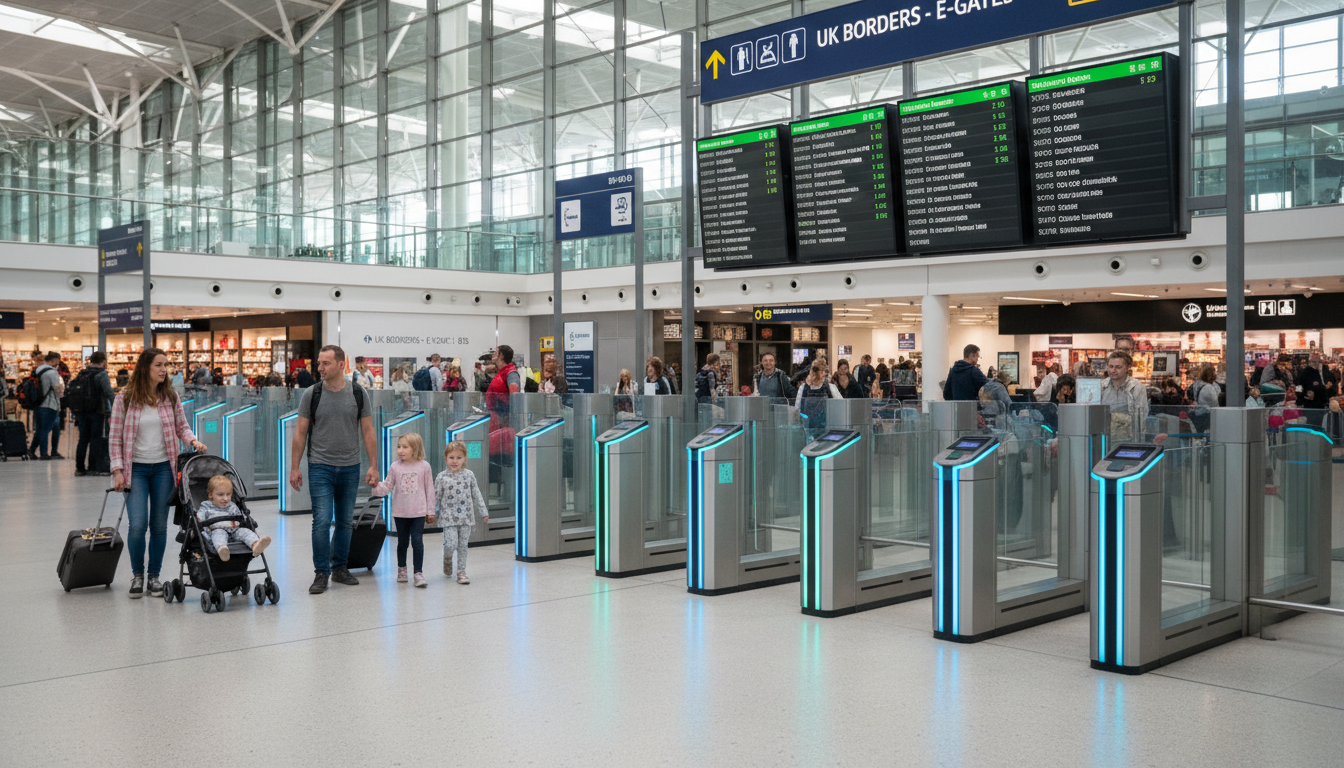
UK Airports to Open E-Gates for Young Travellers
Border staff at major terminals are preparing for a practical change that families will notice at arrivals. Today, airport operators are adjusting passenger flow plans so more children can be routed to automated gates without splitting groups. In the middle of these preparations, rosters and lane signage are already being reviewed, with the UK airport e-gate expansion being treated as an operational change rather than a publicity push. Live queue management teams at several hubs are also being briefed to reduce last minute confusion at the gate line. An Update circulated to airlines emphasises that parents should still follow staff directions at the border. The aim is smoother processing while maintaining consistent checks and safeguarding standards.
New E-Gate Policy Details and Implementation
The Home Office sets the policy framework for e-gates and Border Force delivers it on the floor, so implementation depends on training and system configuration at each airport. Today, the most immediate step is updating rule prompts and staff guidance so child e-gate access is applied consistently at busy banks of arrivals. A Live operations view matters because any change that shifts thousands of passengers needs real time oversight, and for background on how technology pressures shape public risk decisions, see Geopolitics and Tech Are Redrawing Insurer Risk. Separately, the UK travel update environment remains sensitive to disruptions, and an Update on wider national conditions can be followed via BBC analysis of recent UK economic growth. Airports are sequencing the change around peak periods to limit knock on delays.
Impact on Families Travelling Through UK Airports
For families, the biggest difference is that a single household group is less likely to be divided between manual desks and automated channels during arrival surges. Staff supervisors say the operational goal is fewer bottlenecks at the point where parents previously had to peel off with one child while others used e-gates, and in practice, UK airport e-gate expansion can also reduce the number of passengers redirected mid queue, which is a common cause of disputes at the barrier line. Today, airlines are being asked to keep arrival messaging clear so families do not self sort incorrectly. A Live arrival hall is unforgiving when signage and staff calls do not match, and for related London civic context that can affect transport staffing and planning, see London local polls: results and political impact. An Update will follow if airports alter family lane layouts.
Technology Behind E-Gates and Future Innovations
E-gates rely on biometric matching between the chip in an electronic passport and the traveller at the camera, with Border Force officers available to intervene when the system flags an exception. Today, airport technology teams focus on keeping camera calibration and lighting stable, because small failures can cascade into long queues. Live monitoring dashboards track gate uptime, rejection rates, and manual referrals so supervisors can add staff quickly, and at hubs such as Heathrow and Gatwick this data is reviewed during peak arrival banks. An Update to software rules can change how strictly the system checks image quality, which is especially relevant when processing younger faces that may vary more between passport photo and arrival day. The Home Office and its technology partners typically stage changes to reduce the risk of sudden failure across multiple airports. Any future innovation will still be constrained by identity assurance and safeguarding requirements.
Comparing UK E-Gate Policies with Other Countries
Airports and border agencies across Europe have expanded automation at different speeds, often reflecting legal thresholds for biometric processing and the maturity of national identity infrastructure. Today, UK officials emphasise that any access change must still meet Border Force standards, even if other countries take a more permissive approach for family groups. In comparative discussions, the UK airport e-gate expansion is being framed as a measured adjustment rather than a full redesign of border processing. Live comparisons are difficult because passenger mixes differ by season and route structure, and performance depends on staffing as much as technology, with Schengen-area hubs such as Amsterdam Schiphol and Paris Charles de Gaulle often cited in briefings. An Update on any further policy alignment would likely come through formal Home Office guidance and airport operator notices. For now, airports are focused on consistent application so families see predictable outcomes on arrival.