News
Russia Unleashes Heaviest Missile and Drone Barrage on Ukraine This Year

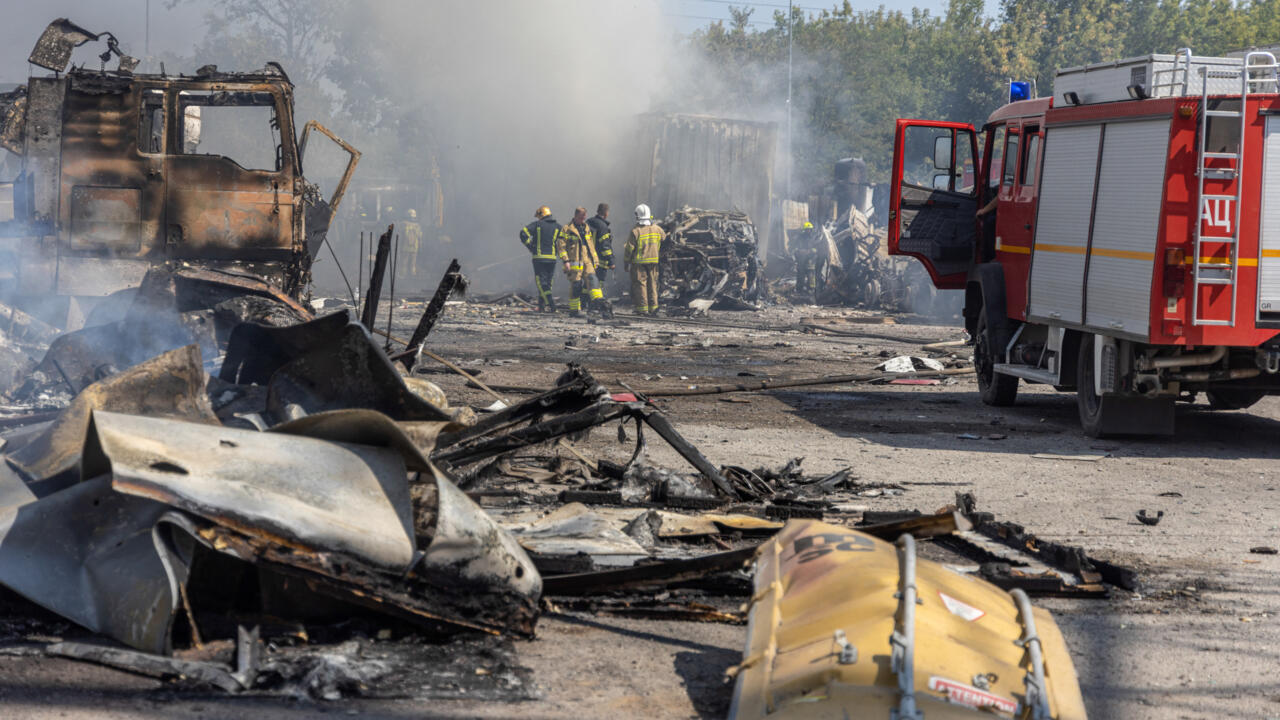
Russia has launched its most intense missile and drone assault on Ukraine so far this year, killing at least four people and causing widespread damage across several regions, Ukrainian authorities said. The overnight strikes, which involved waves of missiles and attack drones, marked a sharp escalation in the tempo of Russian attacks and underscored the continued volatility of the conflict.
Ukrainian officials said air raid sirens sounded for hours as air defence systems were activated across the country. Explosions were reported in multiple cities, with infrastructure, residential buildings, and energy facilities among the targets. Emergency services worked through the night to rescue survivors, extinguish fires, and assess damage as daylight revealed the scale of destruction.
The assault was ordered under the direction of Vladimir Putin, according to Ukrainian and Western officials, who described the operation as a coordinated attempt to overwhelm Ukraine’s air defences. The attack involved a mix of cruise missiles, ballistic missiles, and Iranian-designed Shahed drones, a combination that has become a hallmark of Russia’s long-range strike strategy.
Ukraine’s air force said it managed to intercept a significant number of incoming threats, but acknowledged that some missiles and drones got through. Officials warned that even successful interceptions can result in debris falling onto populated areas, adding to the danger for civilians. Local authorities confirmed fatalities and injuries, though they cautioned that casualty figures could rise as more information becomes available.
The strikes came amid continued fighting along the front lines in eastern and southern Ukraine, where Russian and Ukrainian forces have been locked in grinding battles. Analysts say the timing of the barrage suggests Moscow is seeking to apply pressure both militarily and psychologically, targeting cities far from the front to sap morale and strain resources.
Ukrainian President Volodymyr Zelensky condemned the attack, calling it further evidence that Russia has no intention of de-escalating. He renewed appeals for additional air defence systems and ammunition from Western allies, arguing that protecting civilians and critical infrastructure remains Ukraine’s most urgent need. Ukrainian officials have repeatedly warned that shortages of interceptor missiles could leave cities more vulnerable to mass attacks.
The Russian defence ministry has not commented in detail on the strikes, but Moscow has consistently claimed that its long-range attacks are aimed at military and energy-related targets. Ukraine and its allies reject that narrative, pointing to repeated hits on civilian areas and essential infrastructure, particularly during winter and periods of high energy demand.
International reaction was swift. Several Western governments condemned the barrage and reiterated support for Ukraine, while humanitarian groups warned that intensified strikes increase risks for civilians already facing hardship from power outages and displacement. The United Nations has previously said that attacks on civilian infrastructure may violate international humanitarian law.
The overnight assault highlights how the conflict continues to evolve, with long-range weapons playing an increasingly central role. Russia has relied heavily on missiles and drones to project force deep into Ukraine, while Kyiv has sought to counter these attacks through improved air defences and, increasingly, strikes of its own against targets inside Russia.
As Ukraine assesses the damage and mourns the dead, officials warned that further attacks are likely. With no sign of an imminent ceasefire, the latest barrage reinforces fears that the war is entering another phase of escalation, one in which civilian areas remain at constant risk and the toll of the conflict continues to grow.