
Politics
Pentagon Report: China Likely Loaded Over 100 ICBMs, Raising Global Concerns

Growing Military Ambitions
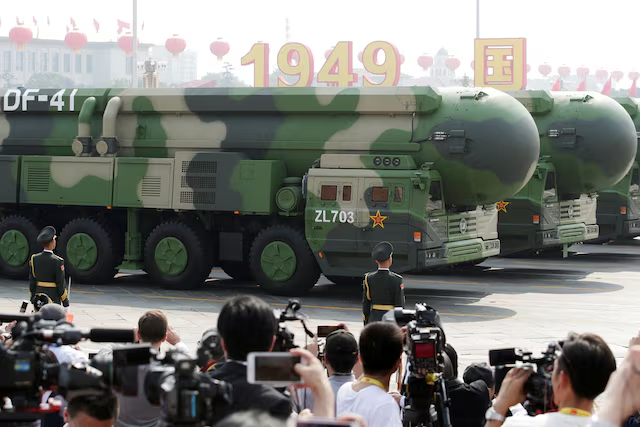
A draft report from the Pentagon reveals that China has likely loaded more than 100 intercontinental ballistic missiles (ICBMs) in its newly constructed silo fields. The report underscores Beijing’s rapid military modernization and signals a growing focus on strategic deterrence. While the Pentagon had previously reported the construction of these silo fields, this is the first indication that they may now be operational and stocked with missiles.
The findings highlight concerns over China’s expanding nuclear capabilities and its apparent reluctance to engage in arms control discussions. According to the report, China has shown no interest in talks that could limit or regulate its stockpile, a stark contrast to traditional arms control frameworks involving other nuclear powers.
Details from the Draft Report
The Pentagon’s draft report, circulated to U.S. lawmakers and officials, indicates that the missile silos are spread across three new fields, strategically placed to enhance China’s nuclear deterrent. While exact locations are classified, analysts believe the fields are part of China’s broader strategy to diversify launch options and improve survivability in case of a nuclear conflict.
The report also emphasizes that China’s nuclear arsenal is modernizing faster than any other nuclear power. This includes the deployment of new ICBMs, mobile launchers, and potential improvements in missile accuracy and range. Analysts say this acceleration reflects Beijing’s intent to project strategic strength globally and to ensure credible second-strike capability against potential adversaries.
China’s Stance and Disputes
Beijing has disputed the Pentagon’s assessment, maintaining that its nuclear forces are purely defensive. Chinese officials argue that the report exaggerates their stockpile and intentions. However, intelligence gathered by the Pentagon suggests that the pace of missile loading and deployment exceeds previous publicly known estimates.
The report also indicates that China currently shows no willingness to participate in arms control negotiations similar to the New START treaty between the United States and Russia. Experts warn that this stance could complicate global efforts to manage nuclear risk and maintain strategic stability.
Implications for U.S. and Global Security
The Pentagon’s findings come at a time when the U.S. is engaged in strategic dialogues with other nuclear powers. President Donald Trump has stated his objective to denuclearize the world, including China and Russia, though experts caution that Beijing is unlikely to reduce its arsenal voluntarily.
Analysts warn that the rapid expansion of China’s nuclear capabilities could trigger a regional arms race in Asia, prompting neighboring countries to enhance their own military preparedness. Moreover, it raises concerns about nuclear command and control systems, the potential for miscalculations, and the security of global deterrence frameworks.
Strategic Takeaways
The report serves as a reminder that global nuclear stability is under pressure. As China continues to expand its strategic arsenal, the United States and its allies may need to reassess deterrence strategies, missile defense systems, and diplomatic engagement.
While China disputes the Pentagon’s claims, the trend of missile deployment and silo expansion is clear. For policymakers, this means balancing deterrence, diplomacy, and monitoring to avoid misjudgments that could escalate tensions.
The Pentagon’s report also highlights the broader geopolitical significance of China’s military modernization, which is increasingly influencing U.S. defense planning and global security calculations.
Conclusion
The potential loading of over 100 ICBMs in China’s new silo fields marks a significant development in global nuclear dynamics. With Beijing showing little interest in arms control, the world faces growing challenges in managing strategic competition, preventing proliferation, and maintaining stability. The coming months are likely to see heightened attention on China’s nuclear posture and renewed discussions among global powers on how to address this evolving threat.



