News
Passenger Recounts Chaos After Head On Train Collision Near Machu Picchu

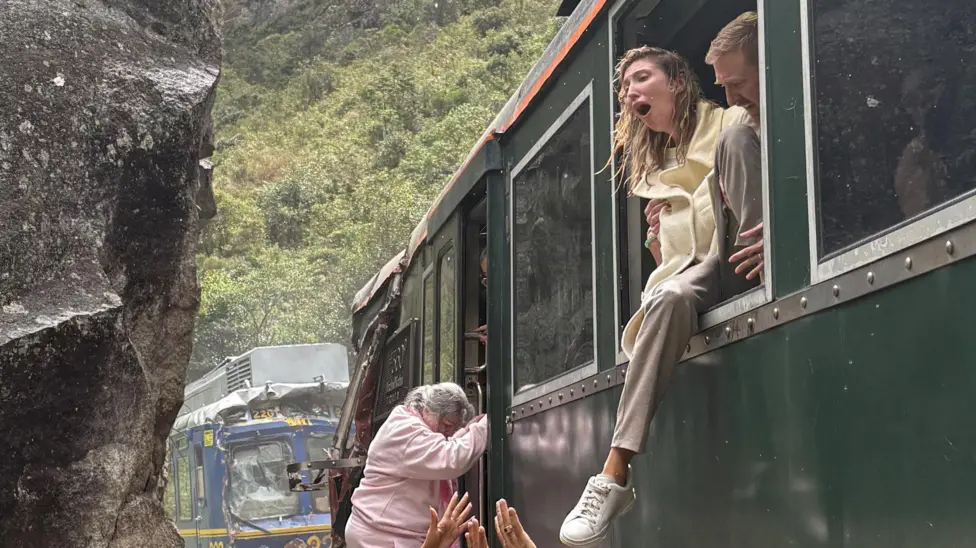
A passenger has described scenes of panic and confusion after two trains collided head on near the Machu Picchu tourist route, injuring dozens of people and disrupting one of Peru’s most heavily used rail lines.
The collision occurred on a section of track used by visitors travelling to and from the ancient Inca citadel of Machu Picchu, a destination that attracts millions of tourists each year. Authorities said the trains were operating on the same line when they struck each other, though the precise cause of the crash remains under investigation.
A passenger who was on one of the trains told local media that the impact was sudden and violent, throwing people from their seats and sending luggage crashing through the carriages. She described hearing screams as passengers tried to understand what had happened and look for injured family members and fellow travellers.
According to emergency services, dozens of passengers were hurt, though none of the injuries are believed to be life threatening. Many of those injured suffered cuts, bruises and suspected fractures, while others were treated for shock at the scene. Several passengers were transported to nearby hospitals for further medical checks.
Rescue teams and police arrived quickly, working alongside railway staff to evacuate passengers from the damaged carriages. Photos shared on social media showed dented train fronts and debris scattered along the track, underscoring the force of the collision.
The railway line involved is operated by companies that provide services between the city of Cusco and Machu Picchu, a route that winds through mountainous terrain and relies on careful coordination due to limited track availability. Rail operators said services were immediately suspended following the crash, leaving hundreds of travellers stranded.
Officials from Peru’s transport authorities said an investigation has been launched to determine whether human error, signalling problems or technical failure played a role. Early reports suggest the line uses sections of single track, requiring strict scheduling and communication to prevent opposing trains from entering the same stretch.
Tourism officials expressed concern about the impact on visitors, noting that Machu Picchu is central to Peru’s tourism economy. Arrangements were made to assist stranded tourists with accommodation, food and alternative transport while rail services remain suspended.
Passengers described mixed emotions after the incident, ranging from fear to relief. Some said they were grateful that the trains were travelling at relatively low speeds when they collided, which may have prevented more serious injuries or fatalities. Others criticised what they saw as a lack of clear information in the immediate aftermath, saying announcements were slow and confusing.
Local authorities said safety inspections are being carried out along the affected section of track and that services will only resume once officials are confident it is safe to do so. Rail operators issued apologies to passengers and pledged full cooperation with investigators.
The collision has renewed scrutiny of rail safety on tourist routes in Peru, particularly those serving remote and heavily visited destinations. Transport experts say the incident highlights the importance of modern signalling systems and rigorous operational protocols, especially on single track lines.
As investigations continue, passengers affected by the crash are being offered support and refunds. For many, the journey meant to culminate in a visit to one of the world’s most famous archaeological sites instead became a frightening ordeal they say they will not soon forget.