News
Lee Jae Myung Meets Xi Jinping in Push to Stabilise China–South Korea Relations

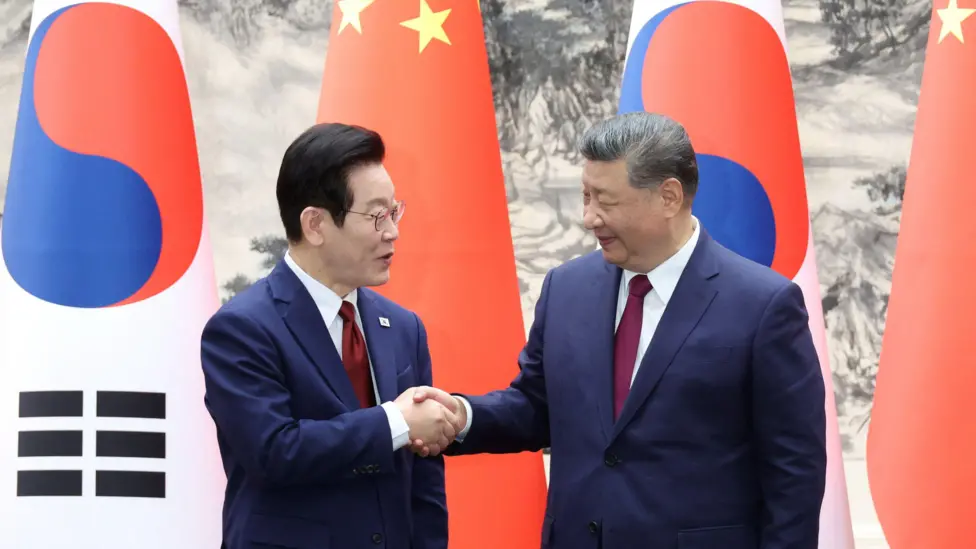
South Korean President Lee Jae Myung met Chinese leader Xi Jinping on Monday in a bid to reset relations with Seoul’s largest trading partner, as regional tensions and economic uncertainty place renewed strain on East Asian diplomacy. The talks mark the second summit between the two leaders since November, when Xi visited South Korea, and signal Lee’s intention to pursue a more predictable and stable relationship with Beijing.
At the heart of the meeting is South Korea’s concern over the fragility of its economic ties with China. China remains South Korea’s biggest export destination, absorbing a significant share of its semiconductors, consumer goods and industrial components. For Lee, maintaining access to the Chinese market is critical at a time when global demand is uneven and supply chains are increasingly shaped by geopolitics.
One key issue on the agenda is regional security. Rising tensions around Taiwan, combined with China’s increasingly assertive posture, have complicated South Korea’s diplomatic calculations. Seoul is a close security ally of the United States, yet deeply economically intertwined with China. Recent diplomatic friction between China and Japan over Beijing’s claims regarding self governed Taiwan has further heightened regional sensitivity, leaving South Korea wary of being drawn into sharper confrontation.
Experts say Lee is seeking reassurances that China will not weaponise economic ties in response to political disagreements. Past disputes, including informal Chinese restrictions on South Korean businesses and cultural exports, have left a lasting impression in Seoul. In particular, Beijing’s unofficial ban on Korean pop culture, which has affected concerts, television content and endorsements, remains a point of frustration for South Korean officials and the creative industry.
Lee’s government has made clear that restoring cultural exchanges is not only a symbolic issue but also an economic one. Korean entertainment is a major export sector, and restrictions have cost companies and artists millions of dollars. Addressing this issue with Xi is seen as part of a broader effort to normalise people to people exchanges and rebuild trust beyond official diplomacy.
From China’s perspective, the meeting offers an opportunity to stabilise relations with a key regional player at a time when Beijing faces pressure on multiple fronts. Maintaining steady ties with South Korea could help China counterbalance closer cooperation between Washington, Tokyo and Seoul, even as it urges regional partners to avoid what it sees as bloc based politics.
Despite the positive optics, analysts caution that expectations should remain modest. Structural challenges remain, including South Korea’s alignment with US led security frameworks and China’s sensitivity over Taiwan. While both leaders may emphasise dialogue and cooperation, neither side is likely to make major concessions in the short term.
Still, the fact that Lee and Xi are meeting again within months suggests a shared interest in preventing further deterioration. For Lee, the priority is ensuring that economic relations with China remain insulated from regional political shocks. For Xi, maintaining influence and stability on China’s periphery remains a strategic imperative.
As East Asia navigates an increasingly complex geopolitical landscape, the outcome of the meeting may not resolve underlying tensions, but it could help establish clearer boundaries and communication channels. In a region where miscalculation carries high risks, even incremental progress toward stability carries significant weight.