News
How a Christmas Raid by Students Reclaimed Scotland’s Stone of Destiny

Seventy-five years ago, a daring act carried out in the early hours of Christmas Day shocked Britain and reignited a long-running debate over history, identity, and ownership. Four Scottish university students broke into London’s Westminster Abbey. They removed one of its most treasured objects, the Stone of Destiny, claiming they were not committing a prank but righting a centuries-old wrong.
The discovery was made on Christmas morning in 1950, when the Dean of Westminster Abbey realised that intruders had entered his residence overnight. Instead of theft for profit, the burglars had taken something far more symbolic. Missing from the Abbey was the Stone of Destiny, also known as the Stone of Scone, a massive block of red sandstone weighing around 150 kilograms. Though unremarkable in appearance, the stone carried enormous historical weight.
For centuries, the Stone of Destiny had been associated with the coronation of Scottish kings. According to tradition, it was used at Scone Abbey in Scotland as the seat upon which monarchs were crowned. Its fate changed in 1296, when England’s King Edward I invaded Scotland and seized the stone, taking it south to London. There, it was placed beneath the wooden Coronation Chair in Westminster Abbey and used in the coronation ceremonies of English and later British monarchs, beginning with William the Conqueror.
To many Scots, the stone’s presence in London symbolised domination and loss. For generations, it was viewed as a stolen national treasure, taken during a time of conquest. That sense of grievance remained strong in post war Scotland, particularly among young people who were becoming increasingly vocal about national identity.
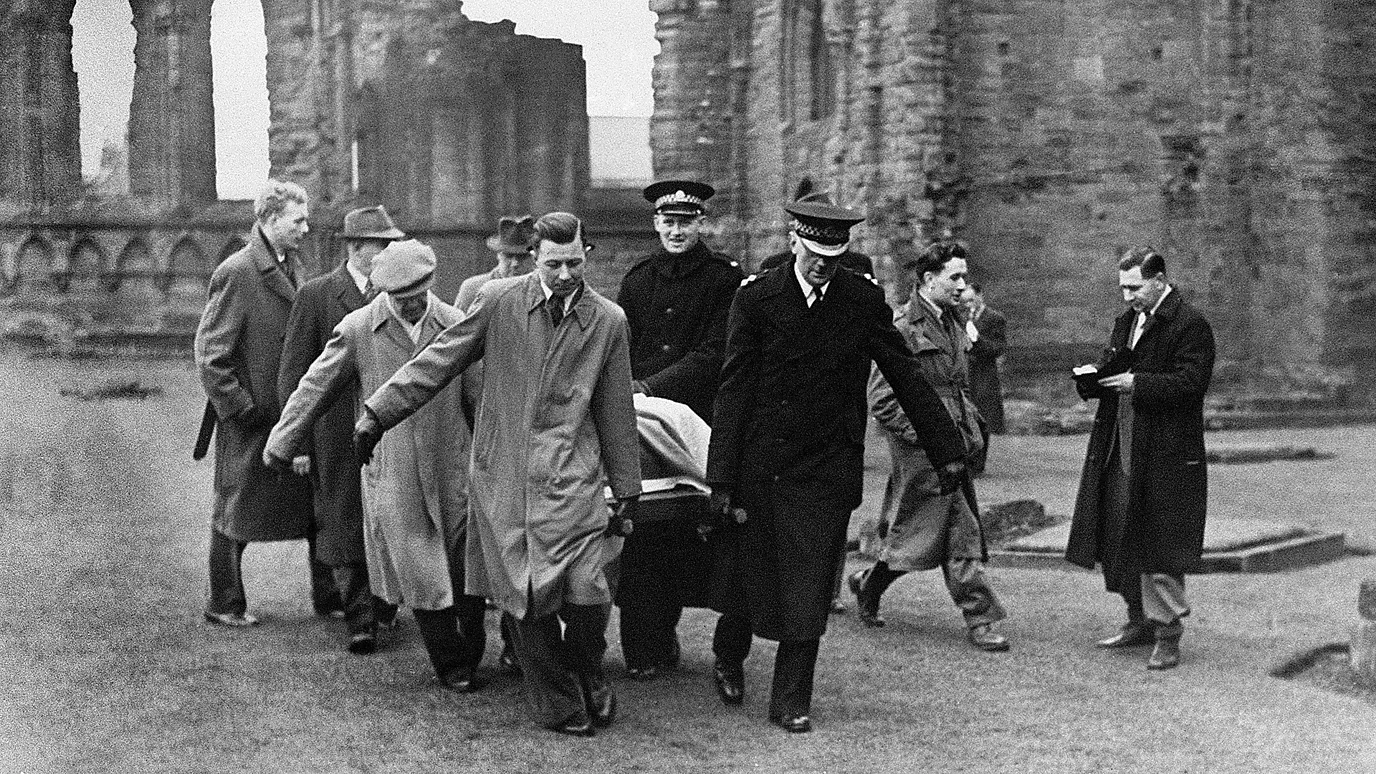
The four students behind the raid believed they were acting in the name of justice rather than mischief. Under the cover of darkness, they managed to enter the Abbey and remove the stone from the Coronation Chair. During the operation, the stone reportedly cracked, adding to the drama of the event. The students then transported it north, triggering a nationwide manhunt and intense media attention.
The disappearance of the Stone of Destiny embarrassed British authorities and sparked debate across the country. Some condemned the act as vandalism and theft, while others quietly admired the audacity and symbolism of the gesture. In Scotland, many saw the students as folk heroes who had reclaimed a piece of national heritage.
After several months, the stone was eventually recovered and returned to Westminster Abbey. The students responsible were never prosecuted, a decision that reflected the political sensitivity surrounding the incident. The episode left a lasting mark on public consciousness and became a powerful symbol of Scottish cultural pride.
Decades later, in 1996, the British government formally returned the Stone of Destiny to Scotland, where it is now kept at Edinburgh Castle, with the understanding that it will be returned to London for future coronations. The Christmas raid of 1950 is now remembered not just as a bold heist, but as a moment when history, protest, and national identity collided in a dramatic and unforgettable way.