News
Greenland Would Choose Denmark Over United States, Prime Minister Says Amid Annexation Talk

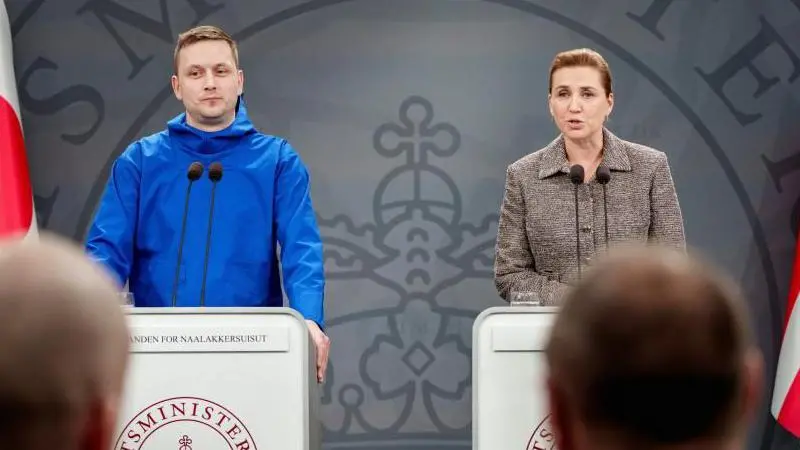
Greenland’s prime minister has said that if his people were forced to choose between Denmark and the United States, they would choose Denmark, delivering his strongest rejection yet of renewed US ambitions to take control of the Arctic territory. The comments come as debate intensifies over Greenland’s future and its role in growing geopolitical competition in the Arctic.
Speaking at a joint news conference with Denmark’s prime minister, Jens-Frederik Nielsen said the choice was clear “here and now.” His remarks were widely interpreted as a direct response to statements by Donald Trump, who has revived the idea of annexing Greenland and described the island as strategically vital to US interests.
Greenland is a semi-autonomous territory within the Kingdom of Denmark, with control over most domestic affairs but with Copenhagen retaining responsibility for defence and foreign policy. While Greenland has gradually expanded its self-rule over the past decades and continues to debate eventual independence, its leaders have repeatedly rejected any suggestion that the island could be absorbed by another country.
Nielsen’s comments mark the clearest statement so far from Greenland’s leadership since Trump renewed his push. Standing alongside Denmark’s prime minister, he emphasized that Greenland’s relationship with Denmark is based on shared history, legal frameworks, and democratic consent, even as discussions about greater autonomy continue. He said Greenlanders want to decide their own future without external pressure.
Trump’s interest in Greenland has reignited international attention on the island’s strategic value. Greenland occupies a key position between North America and Europe and is increasingly important as climate change opens Arctic sea routes and access to natural resources. The island is also believed to hold significant reserves of rare earth minerals, which are critical for modern technologies and defence industries.
The United States already maintains a military presence in Greenland and has long viewed the island as central to Arctic security. However, Greenlandic leaders have drawn a firm line between cooperation and sovereignty. Nielsen said that while Greenland values strong partnerships, particularly on security and economic development, these must be built on respect and consent.
Denmark’s prime minister welcomed Nielsen’s remarks, reaffirming Copenhagen’s support for Greenland’s right to self-determination. Danish officials have repeatedly said Greenland is not for sale and that any discussion of its future must involve the Greenlandic people themselves. Trump’s comments have been described in Denmark as unacceptable and destabilising for allied relations.
Within Greenland, public opinion strongly favours maintaining control over local affairs and resources. While independence from Denmark remains a long-term aspiration for some political groups, surveys and political debate suggest there is little appetite for becoming part of the United States. Many Greenlanders are concerned that external powers see the island primarily through a strategic or economic lens rather than as a society with its own culture and priorities.
Analysts say Nielsen’s statement reflects a broader effort by Greenland’s leaders to assert agency amid intensifying global interest in the Arctic. As competition between major powers grows, Greenland is seeking to reinforce its voice and ensure it is treated as a political actor rather than a prize.
The remarks are also likely to resonate within Nato, where Denmark is a key member and Arctic security has become an increasing focus. Greenland has said it supports defence arrangements under alliance frameworks rather than unilateral control by any single country.
For now, Nielsen’s message is clear. Greenland wants partnership, not takeover, and any choice about its future belongs to Greenlanders themselves. By publicly stating a preference for Denmark over the United States, the prime minister has set firm boundaries as geopolitical pressure around the Arctic continues to build.