
Politics
China Condemns U.S. Seizure of Oil Tankers, Calls It Violation of International Law

Rising Tensions Over Venezuelan Oil
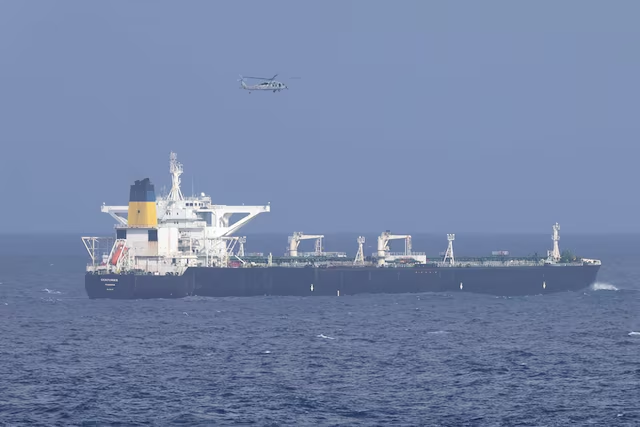
China has strongly condemned the United States following the interception of a China-bound oil tanker off the coast of Venezuela. The vessel, identified as the Centuries, was carrying approximately 1.8 million barrels of Venezuelan crude. Beijing’s foreign ministry labeled the seizure a serious violation of international law and accused Washington of acting unilaterally.
China’s spokesperson, Lin Jian, emphasized that Venezuela has the sovereign right to trade and develop relationships with other countries. He criticized “unilateral and illegal sanctions,” reiterating China’s opposition to actions that interfere with international trade. The statements come amid growing tensions over U.S. sanctions on Venezuela and the role of Chinese companies in buying its crude oil.
Details of the Interception
The U.S. Coast Guard intercepted the tanker Centuries in international waters east of Barbados. The vessel had reportedly been operating under a false name, Crag, and was part of Venezuela’s shadow oil fleet. According to documents, the cargo was purchased by Satau Tijana Oil Trading, one of several intermediaries working with PDVSA, Venezuela’s state oil company, to supply Chinese independent refiners.
The seizure follows President Donald Trump’s announcement of a blockade on all sanctioned Venezuelan oil tankers, aimed at enforcing U.S. sanctions and curbing the flow of Venezuelan crude to international markets. The White House stated that the Centuries was carrying sanctioned oil, justifying the interception under U.S. policy.
Reactions from China and Venezuela
China’s reaction has been firm, signaling that it views the U.S. action as overstepping international norms. Lin Jian warned that such interventions undermine global trade rules and international maritime law, suggesting that the incident could have long-term implications for U.S.-China relations.
Venezuela has also condemned the interception, labeling it a “serious act of international piracy.” Caracas argues that Washington’s blockade infringes on its sovereignty and ability to trade freely. For Venezuela, oil exports are a critical part of the economy, and Chinese demand accounts for roughly 4% of China’s crude imports, making it a vital trading partner.
Global Implications
The incident highlights the geopolitical complexity of sanctions and maritime enforcement. With the U.S. targeting Venezuelan oil shipments and China asserting its trade rights, tensions in the Caribbean and broader global oil markets are rising. Analysts suggest that such actions could strain U.S.-China relations further and potentially impact global oil prices due to concerns about the security of Venezuelan crude shipments.
The situation also underscores the challenges of enforcing sanctions in international waters. With tankers frequently operating under false flags or intermediary companies, enforcement becomes a diplomatic and logistical challenge. Experts note that unilateral measures like the U.S. blockade may provoke pushback from countries that rely on Venezuelan oil, particularly China.
Looking Ahead
As global attention focuses on the U.S.-China-Venezuela triangle, observers are watching for potential diplomatic negotiations or retaliatory measures. How the U.S. and China resolve these disputes over trade and maritime law could set precedents for future interactions in regions with strategic natural resources.
With Venezuela’s crude exports critical to Chinese refineries and U.S. sanctions aimed at curbing Maduro’s government, the situation is likely to remain tense. Both Beijing and Caracas have indicated that they will not back down, raising the prospect of escalating diplomatic confrontations.
The Centuries tanker incident is a reminder of the interconnectedness of global energy markets and the growing role of geopolitics in international trade enforcement. How the U.S., China, and Venezuela navigate these challenges will have implications for energy security, international law, and broader U.S.-China relations in 2026.



