Tech
A hospital scan transformed by an unexpected breakthrough

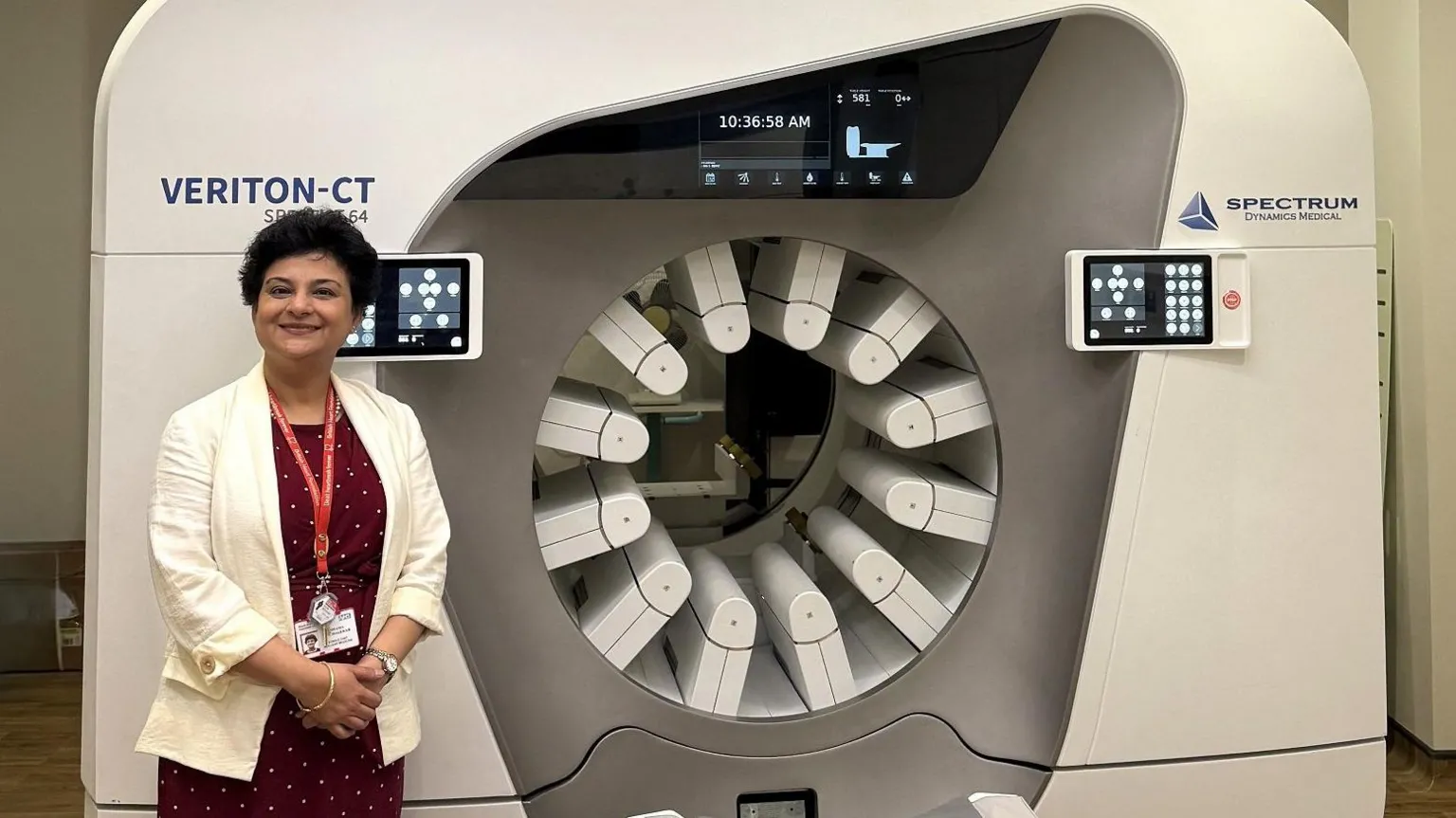
For patients undergoing certain lung scans at London’s Royal Brompton Hospital, the experience used to be long and uncomfortable. People were required to lie flat inside a large scanner with their arms raised above their heads for as long as forty five minutes. Remaining completely still for that length of time was difficult, particularly for patients already struggling with breathing problems. That changed last year when the hospital introduced a new scanning device that reduced examination times to just fifteen minutes.
The science behind faster clearer imaging
The dramatic improvement is partly due to advanced image processing software, but a lesser known material has played a crucial role. The scanner uses cadmium zinc telluride, commonly referred to as CZT, a compound that allows detectors to capture gamma rays with exceptional precision. This capability enables the machine to produce highly detailed three dimensional images of the lungs, giving clinicians clearer insight while shortening the time patients spend in the scanner.
Dr Kshama Wechalekar, head of nuclear medicine and PET at the hospital, describes the results with enthusiasm. She says the images produced by the new scanner are remarkably clear, calling it an extraordinary achievement in both engineering and physics. For doctors, this clarity translates into greater confidence when diagnosing complex lung conditions.
A British firm behind a rare material
The CZT used in the scanner was produced by Kromek, a British technology company that is among only a handful worldwide capable of manufacturing the material. While most people have never heard of cadmium zinc telluride, specialists see it as transformative. According to Dr Wechalekar, CZT is driving a quiet revolution in medical imaging by improving accuracy while reducing patient burden.
Producing CZT is technically challenging, which is why so few companies can do it at scale. The process requires precise control of crystal growth to ensure the material can detect radiation reliably. This expertise has made CZT increasingly valuable across multiple industries.
Beyond hospitals and healthcare
Although its impact on medical imaging is attracting attention, CZT has a much wider range of uses. The material is also found in X ray telescopes used to observe distant objects in space, radiation detectors designed for safety monitoring, and security scanners at airports. As demand for advanced detection technologies grows, interest in CZT continues to rise across scientific and commercial sectors.
In healthcare, its benefits are particularly significant. CZT based detectors are more sensitive than older technologies, allowing scanners to operate with smaller amounts of radioactive tracers. This improves patient safety while maintaining or even enhancing diagnostic quality.
Improving diagnosis for complex lung conditions
At Royal Brompton Hospital, the new scanner is being used to investigate a range of lung problems. Doctors examine patients for tiny blood clots that may be present in people suffering from long Covid, as well as larger clots such as pulmonary embolisms. These conditions can be difficult to detect and often require highly detailed imaging to guide treatment decisions.
The scanner works by detecting gamma rays emitted by a small amount of radioactive substance injected into the patient. Thanks to CZT’s sensitivity, clinicians can reduce the dose of this substance by about thirty percent compared with older scanners. This reduction is particularly important for patients who may need repeated scans over time.
A recent step forward in scanner design
While CZT based scanners have existed for some time, large whole body scanners using the material are a relatively recent development. The system installed at Royal Brompton last August represents a new generation of imaging equipment designed to balance comfort, safety, and diagnostic power. With a price tag of around one million pounds, it also reflects the level of investment being made in advanced medical technology.
A quiet revolution in patient care
For patients, the benefits are immediate and tangible. Shorter scan times mean less discomfort and anxiety. For clinicians, sharper images and lower radiation doses improve both diagnosis and long term care. Cadmium zinc telluride may not be widely known, but its impact is being felt every day in hospital rooms where faster, clearer scans are changing how medicine is practiced.