Business
Trump and the Fed Chair Clash in an Extraordinary Test of Monetary Authority

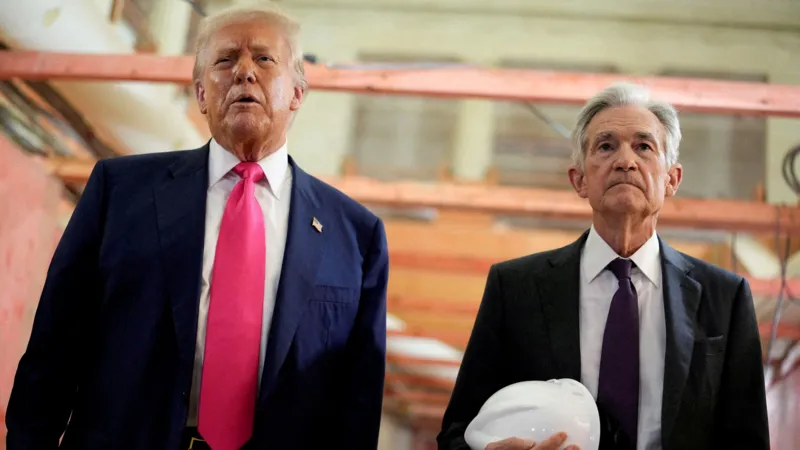
It is rare for the world’s most powerful central banker to address the public through an unscheduled social media video. When Jerome Powell appeared online to defend his position, the moment felt surreal even by today’s political standards. For many observers, the first instinct was disbelief, shaped by an era in which artificial intelligence has blurred the boundary between reality and fabrication. Yet this was no deepfake. It was a real and extraordinary intervention that underscored how far tensions have escalated between the US president and the Federal Reserve.
A clash that goes beyond personality
At its core, the dispute is not simply about personal animosity. It reflects a fundamental disagreement over the role of central banking in a politically charged environment. Donald Trump has repeatedly criticised the Federal Reserve for refusing to cut interest rates aggressively, arguing that tighter policy harms growth and undermines his economic agenda.
Powell, by contrast, has maintained that interest rate decisions must remain grounded in inflation data, labour market conditions and long term financial stability. This difference in philosophy has simmered for years, but the public nature of the latest exchange has elevated it into unprecedented territory.
Why Powell’s video matters
Central bank communication is usually cautious, formal and choreographed. Press conferences, written statements and congressional testimony are the standard channels. A spontaneous video message represents a sharp departure from tradition, signalling that Powell believes the stakes have changed.
By speaking directly to the public, Powell appears to be defending not only his own credibility but also the institutional independence of the Federal Reserve. The move suggests concern that conventional channels are no longer sufficient to counter political pressure and public misunderstanding.
The wider implications for global markets
The Federal Reserve’s influence extends far beyond US borders. Its interest rate decisions shape global capital flows, currency valuations and borrowing costs across emerging and developed economies alike. When conflict erupts between the White House and the Fed, markets take notice.
Even the perception that monetary policy could be swayed by political pressure risks increasing volatility. Investors depend on the assumption that the Fed operates independently, free from short term electoral considerations. Powell’s visible pushback may reassure some markets, but the public confrontation itself introduces uncertainty.
Politics, perception and the age of distrust
The initial reaction of wondering whether Powell’s video was authentic speaks volumes about the current media environment. Deepfakes, misinformation and politicised narratives have eroded trust in official communication. For central bankers, whose authority rests heavily on credibility, this is a dangerous landscape.
Trump has leveraged this environment effectively, using direct communication channels to frame economic debates in simple, populist terms. Powell’s decision to engage more visibly may reflect an attempt to reclaim narrative control, but it also exposes the Fed to the same polarised scrutiny that engulfs elected officials.
An institutional stress test
This episode represents a stress test for American institutional norms. For decades, the separation between political leadership and monetary policy has been a cornerstone of economic stability. While disagreements have always existed, they were typically managed behind closed doors.
The current spat risks normalising public pressure on central bankers, potentially altering expectations for future administrations. If interest rate decisions become seen as political battlegrounds, the long term cost could be higher inflation, weaker policy credibility and diminished global confidence in US economic governance.
Why this moment feels different
What makes this confrontation extraordinary is not just its visibility, but its timing. It unfolds amid global economic uncertainty, persistent inflation concerns and growing scepticism toward institutions. In such conditions, symbolic moments carry outsized weight.
Powell’s unscheduled appearance was not a routine clarification. It was a signal that the traditional buffers protecting monetary independence are under strain. Whether this marks a temporary escalation or a lasting shift remains to be seen, but the episode has already entered the history of modern central banking as a line rarely crossed.