News
Russia deploys Oreshnik missile in major overnight strike on Kyiv

Russia has used its Oreshnik ballistic missile in a large scale overnight assault on Ukraine, marking only the second confirmed deployment of the weapon since it entered service and signalling a further escalation in Moscow’s long range strike capabilities.
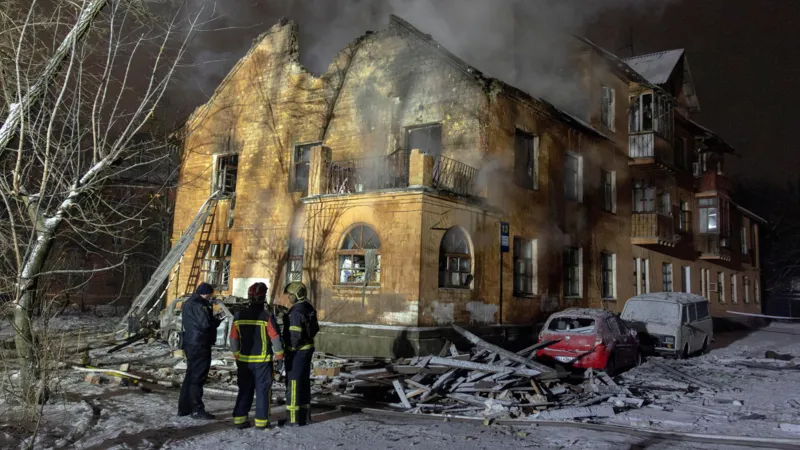
Ukrainian authorities said four people were killed and at least 25 others injured in Kyiv during the attack, which lasted several hours on Thursday night. Residents across the capital reported loud explosions and flashes lighting up the sky as air defence systems engaged incoming missiles and drones. Emergency services were deployed across multiple districts, responding to fires and damaged buildings.
The Oreshnik missile was used as part of a broader wave of strikes targeting Kyiv and other locations, according to Ukrainian officials. While Russia has not publicly detailed the scale of the operation, military analysts say the inclusion of the Oreshnik suggests an effort to test advanced systems under real combat conditions.
It is only the second time Russia has used the missile in the conflict. The first confirmed deployment occurred in November 2024, when the weapon was launched against the central Ukrainian city of Dnipro. At the time, its appearance drew attention because the Oreshnik had not previously been seen in active use, prompting speculation about its role within Russia’s evolving missile arsenal.
The missile is believed to be designed for high speed, long range strikes, complicating interception efforts. Ukrainian air defence units have significantly improved their ability to counter incoming threats, but officials acknowledge that advanced ballistic missiles remain among the most difficult to stop.
In Kyiv, the attack caused damage to residential buildings and infrastructure, with windows shattered and debris scattered across streets. Power outages were reported in some neighbourhoods, though authorities said electricity was restored to most areas by morning. Hospitals treated victims for shrapnel injuries, burns and trauma related to the explosions.
President Volodymyr Zelensky condemned the attack, calling it further evidence that Russia is unwilling to de escalate the conflict. He reiterated calls for continued international support, particularly in air defence systems capable of countering ballistic missile threats.
Russia’s use of the Oreshnik comes amid intensified strikes on Ukrainian cities during the winter period, when attacks on energy and civilian infrastructure have increased pressure on the population. Analysts say Moscow may be seeking to demonstrate both technological capability and strategic resolve at a time when battlefield dynamics remain fluid.
Western defence experts note that the limited use of the Oreshnik so far suggests it may still be undergoing operational testing. Deploying such weapons sparingly allows Russia to gather data on performance, accuracy and Ukraine’s defensive responses without committing large numbers of missiles.
Ukrainian officials said air defence systems intercepted many incoming threats during the night, preventing higher casualties. Nevertheless, the attack has renewed concern about the vulnerability of major cities to advanced missile systems, even as defences improve.
Kyiv residents described a tense night marked by repeated air raid sirens and prolonged sheltering. Many said the sustained explosions were among the most intense experienced in recent months, underscoring the psychological toll of continued long range attacks.
The strike is likely to feature in upcoming diplomatic discussions, as Ukraine and its allies push for additional military assistance. Officials argue that Russia’s willingness to deploy newer missile systems reinforces the need for sustained and enhanced support.
As the conflict enters another year, the appearance of the Oreshnik missile highlights how technological escalation continues to shape the war. While its strategic impact remains limited for now, its use sends a clear signal that Moscow is prepared to expand the range of weapons employed against Ukraine, even as civilian areas remain under threat.