
News
Six whales die as rescuers race to save survivors after mass stranding in New Zealand

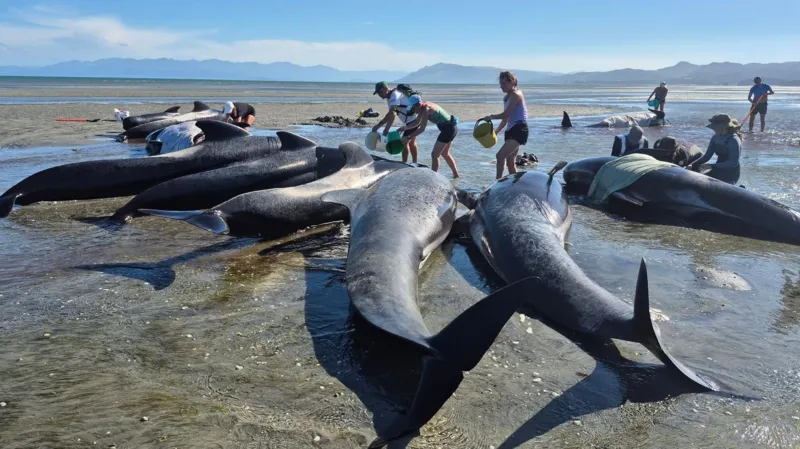
Six whales have died following a mass stranding on a remote beach in New Zealand’s South Island, as volunteers and wildlife officials work urgently to return surviving animals to the sea.
The stranding occurred at Farewell Spit, a long, isolated sandspit known as one of the country’s most frequent whale stranding sites. On Thursday, around 55 pilot whales washed ashore, prompting an immediate response from conservation authorities and local volunteers.
Most of the whales were initially able to refloat and swim back into deeper water, offering early hope that the incident would end with minimal losses. However, 15 whales later restranded along roughly one kilometre of beach, exposed to the elements and the stress of repeated grounding. Despite rescue efforts, six of those animals died.
Teams from the Department of Conservation said the remaining whales are being closely monitored as rescuers race against time. Volunteers have been keeping the animals cool, covering them with wet sheets and digging shallow trenches to allow water to circulate around their bodies while waiting for suitable tidal and weather conditions to attempt another refloat.
Pilot whales are highly social animals, and experts say their strong group bonds are a key reason mass strandings occur. When one whale becomes disoriented or ill and strands, others may follow in an attempt to stay together, often leading to dozens of animals beaching at once.
Farewell Spit’s geography also plays a major role. The shallow waters, gently sloping seabed and complex tidal patterns can confuse whales that rely on echolocation to navigate. Once inside the bay, it can be difficult for large marine mammals to find their way back out to open ocean.
Rescue operations at the site are logistically challenging due to its remoteness and lack of road access in some areas. Volunteers must often walk long distances across sand to reach stranded animals, carrying equipment and supplies. Weather conditions, including wind and temperature, can also affect both the whales’ survival and the safety of rescuers.
Officials stressed that while every effort is being made to save the remaining whales, not all rescue attempts are successful. Whales that have been stranded for extended periods can suffer internal injuries from their own weight, dehydration and stress, reducing their chances of survival even if they are refloated.
The deaths have saddened local communities and wildlife advocates, with images of the stranded whales highlighting the emotional toll of such events. New Zealand has one of the highest rates of whale strandings in the world, and large scale incidents at Farewell Spit are sadly not uncommon.
Conservation staff said decisions about further refloating attempts will depend on the condition of the surviving whales and the timing of tides. In some cases, rescuers may decide not to refloat animals if the risk of immediate restranding or suffering is too high.
Scientists continue to study why strandings occur so frequently in certain locations and whether factors such as disease, ocean noise or climate related changes in sea conditions play a role. While some causes remain unclear, officials say public awareness and volunteer response have greatly improved survival rates in recent years.
For now, attention remains focused on the remaining whales spread along the beach. As the tide cycle continues, rescuers hope that conditions will allow another attempt to guide the animals safely back to sea, even as the loss of six whales serves as a stark reminder of how fragile such rescue efforts can be.



