News
Reeves Condemns Farage Over Opposition to Lifting Two Child Benefit Cap

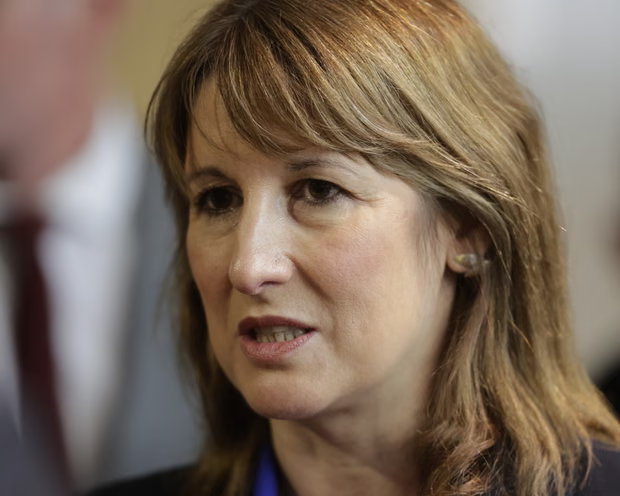
Chancellor Rachel Reeves has sharply criticised Nigel Farage for opposing the removal of the two child benefit cap, accusing him of promoting policies that would keep children in poverty based on their background rather than their needs.
Reeves said she was angered by Farage’s suggestion that the cap should only be lifted for British born families, arguing that such an approach would discriminate against children and undermine the principle that support should be based on hardship, not origin. She said the comments revealed a fundamental divide over values, with the government focused on reducing child poverty and Farage’s approach, in her words, excluding families based on who they are.
The chancellor is set to introduce legislation on Thursday to scrap the two child benefit limit, a policy that has restricted additional support for families with more than two children since its introduction. Reeves said lifting the cap had been a personal priority, but that she had been unable to act sooner due to the need to ensure economic and market stability before making a major fiscal change.
She said the decision to move forward now reflected improved conditions and a belief that tackling child poverty must be central to economic recovery. Reeves described the cap as a significant burden on low income families, adding that its removal would provide relief to hundreds of thousands of children across the country.
Farage, speaking at a press conference on Wednesday, said his party, Reform UK, would vote against scrapping the two child limit, despite earlier indications that he might support the change. He said he was concerned that lifting the cap would benefit large numbers of foreign born people, framing his opposition as a matter of fairness and control over public spending.
His remarks prompted an immediate backlash from senior figures in government. Reeves said the idea of separating children into categories based on birth or heritage was morally wrong and economically short sighted. She said poverty does not discriminate, and that policies designed to reduce it should not either.
The two child benefit cap has been one of the most controversial welfare policies of recent years. Critics have long argued that it disproportionately affects larger families and pushes children into hardship, while supporters have said it encourages responsibility and limits welfare spending. Independent studies have linked the policy to rising child poverty rates, particularly in areas with high living costs.
Reeves said lifting the cap was not about encouraging larger families, but about recognising the reality faced by parents already struggling to make ends meet. She stressed that children should not be punished for circumstances beyond their control and that social security should provide a safety net, not deepen inequality.
Political analysts say the clash highlights a wider divide ahead of upcoming parliamentary votes on welfare reform. While the government is seeking to frame the move as a necessary step to address poverty and social cohesion, opponents like Farage are using the issue to sharpen arguments around immigration and entitlement.
As the legislation is introduced, attention will turn to how the debate plays out in parliament. For Reeves, the issue is both economic and moral. For Farage, it has become a line in the sand on identity and welfare. The outcome is likely to shape not only benefit policy but the tone of wider political arguments around fairness, belonging and social responsibility in the months ahead.