News
UK and France Carry Out Joint Air Strike on Islamic State Arms Site in Syria

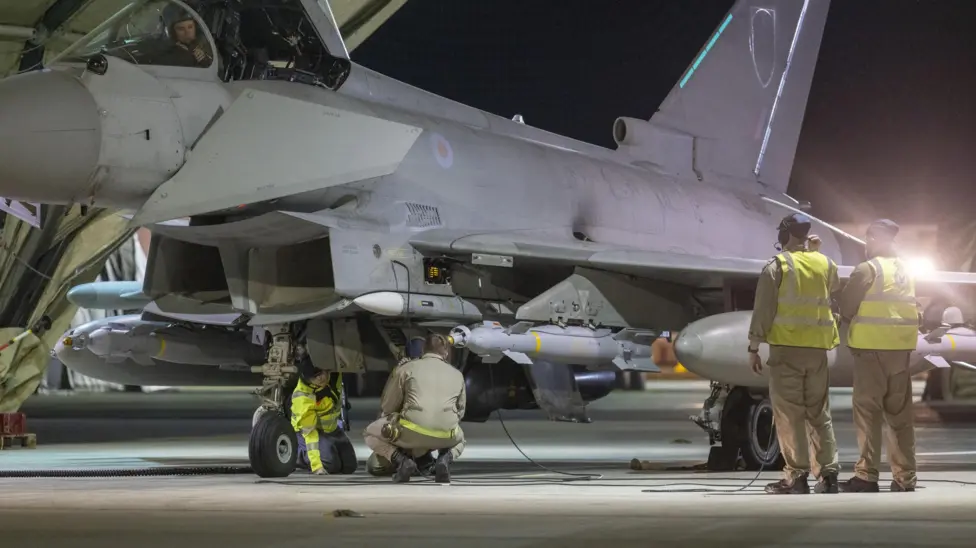
British and French forces have carried out a coordinated air strike on an underground weapons facility used by the Islamic State group in central Syria, in a rare publicly acknowledged joint operation between the two countries. The UK Ministry of Defence said Royal Air Force Typhoon jets worked alongside French aircraft to destroy the site, which intelligence assessments indicated was being used to store arms and explosives.
According to the ministry, the strike followed what officials described as careful and extensive intelligence analysis. The underground bunker was located in mountainous terrain just north of Palmyra, an ancient city that has long held strategic and symbolic importance in Syria. Military planners believed the location was being used by Islamic State militants as a concealed arms cache to support ongoing operations in the region.
The operation was presented as a targeted action designed to degrade Islamic State’s remaining capabilities rather than a broader escalation. Officials said the decision to strike was based on confidence that the site was being used exclusively for militant activity and that the risk to civilians and nearby infrastructure had been minimised. No civilian casualties were reported, though independent verification remains difficult due to limited access to the area.
The Islamic State group, while significantly weakened since the collapse of its self declared caliphate, continues to operate in parts of Syria, particularly in remote desert and mountainous areas. Militants have relied on hidden supply routes and underground facilities to store weapons and explosives, allowing them to launch sporadic attacks against local forces and maintain a presence despite sustained pressure from regional and international actors.
The location near Palmyra is especially sensitive. The city, a UNESCO listed heritage site, suffered extensive damage during earlier phases of the conflict when Islamic State militants captured and later lost control of the area. Military officials said the strike was conducted at a sufficient distance from the ancient ruins to avoid further damage to historically significant structures.
The involvement of both the United Kingdom and France highlights continued European engagement in counter terrorism operations in the Middle East. While the United States has traditionally led the international campaign against Islamic State, European powers have maintained a role, particularly in intelligence sharing, air operations and support for local partners.
Defence analysts say the joint strike also carries political significance. Cooperation between London and Paris on overseas military operations has remained strong despite wider geopolitical shifts in recent years. Coordinated action in Syria sends a signal that both countries remain committed to preventing Islamic State from regrouping and exploiting instability.
French defence officials confirmed their participation in the operation, describing it as part of ongoing efforts to disrupt terrorist networks that pose a threat beyond the region. Both governments emphasised that Islamic State, although diminished, still represents a security concern capable of inspiring or directing attacks internationally.
Syria’s complex security environment complicates counter terrorism efforts. The country remains fragmented after years of civil war, with multiple foreign militaries, militias and local forces operating across its territory. This patchwork has allowed extremist groups to survive by exploiting ungoverned spaces and shifting alliances.
For the UK, the use of RAF Typhoon jets reflects its continued reliance on air power rather than large scale ground deployments. Officials argue that precision strikes, guided by high quality intelligence, are the most effective way to limit militant capabilities while avoiding deeper military entanglement.
The strike near Palmyra underscores a broader reality. Even years after losing territorial control, Islamic State has not been eliminated. As long as instability persists in parts of Syria, Western and regional powers are likely to continue selective military actions aimed at preventing the group from rebuilding its operational strength.