Business
UK Startup Pushes Manufacturing Beyond Earth With Space Based Factory

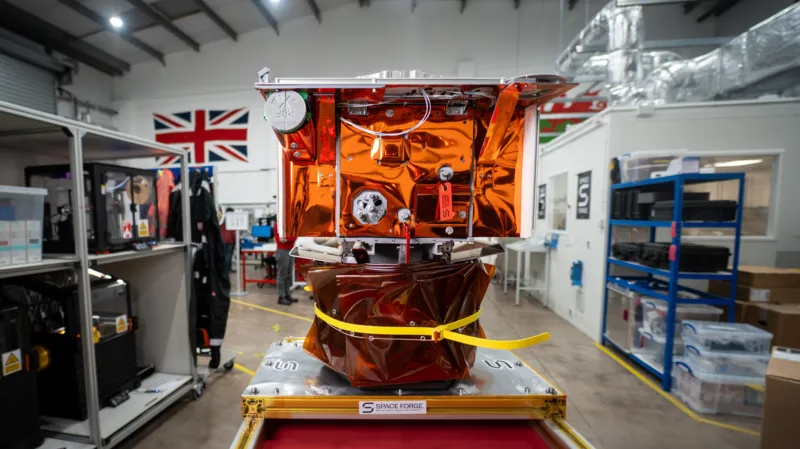
A UK technology company is moving industrial production beyond the planet, turning what once sounded like science fiction into a serious commercial ambition. A Cardiff based startup has successfully sent a compact manufacturing unit into orbit, marking a major milestone in the emerging space manufacturing economy. The achievement signals growing confidence that advanced materials can be produced in space and later returned to Earth for use in high value industries.
A Factory Designed for Orbit
The company behind the breakthrough, Space Forge, has launched a microwave sized factory into space and confirmed that its onboard furnace can operate at temperatures reaching around 1,000 degrees Celsius. This demonstration is critical because extreme and stable heat is required to produce advanced materials with precise structural properties.
Operating a furnace in orbit is technically complex. Power supply, thermal control, and system reliability all become more challenging in microgravity and vacuum conditions. By successfully switching on the furnace and sustaining high temperatures, the company has proven that controlled industrial processes are possible far above Earth’s surface.
Why Manufacture Materials in Space
The commercial logic behind space manufacturing lies in the unique environment of orbit. Microgravity allows materials to form without the distortions caused by gravity on Earth. This can result in purer crystal structures, fewer defects, and improved performance characteristics, especially for advanced electronic materials.
For semiconductor production, even microscopic imperfections can limit efficiency and reliability. Manufacturing key components in space could lead to faster processors, more efficient power systems, and longer lasting electronics. These advantages make space produced materials highly attractive despite the cost of launching hardware into orbit.
Focus on Semiconductors and High Value Applications
Space Forge plans to manufacture materials used in semiconductors, which are essential to modern economies. Chips underpin communications infrastructure, data centres, transport systems, and emerging technologies such as autonomous vehicles and artificial intelligence. Demand for high performance semiconductors continues to rise, while supply chains remain vulnerable to disruption.
By producing materials in space and returning them to Earth, the company aims to complement rather than replace existing semiconductor manufacturing. The goal is to supply ultra high quality inputs that improve final products and give manufacturers a competitive edge.
Cardiff Emerges as a Space Innovation Hub
The success of this mission also highlights the growing role of regional UK cities in the global space economy. Based in Cardiff, Space Forge reflects a broader shift away from space innovation being concentrated only in traditional aerospace centres. Government support, private investment, and university research have helped create an ecosystem where ambitious space startups can thrive.
This decentralisation of space technology development strengthens the UK’s position in the global market. It also demonstrates how advanced manufacturing and space innovation can drive regional economic growth and high skilled employment.
Commercial Challenges and Investor Interest
Despite the progress, significant challenges remain. Launch costs, recovery logistics, and regulatory approval all influence the commercial viability of space manufacturing. The ability to safely return manufactured materials to Earth at scale will be as important as producing them in orbit.
However, investor interest in space based manufacturing is growing. As launch costs decline and satellite technology matures, the economic case becomes stronger. Space Forge’s successful furnace test provides tangible proof that space manufacturing can move beyond theory into operational reality.
A New Frontier for Industrial Production
The idea of factories operating hundreds of kilometres above Earth is no longer confined to imagination. With this latest achievement, the UK company has shown that space can function as an extension of the industrial supply chain.
As global demand for advanced materials increases, space manufacturing may become a strategic advantage rather than a novelty. Space Forge’s orbital factory represents an early but important step toward a future where production is no longer limited by gravity, geography, or traditional industrial constraints.