Business
How Artificial Intelligence Is Reshaping Recovery After Life Changing Injuries

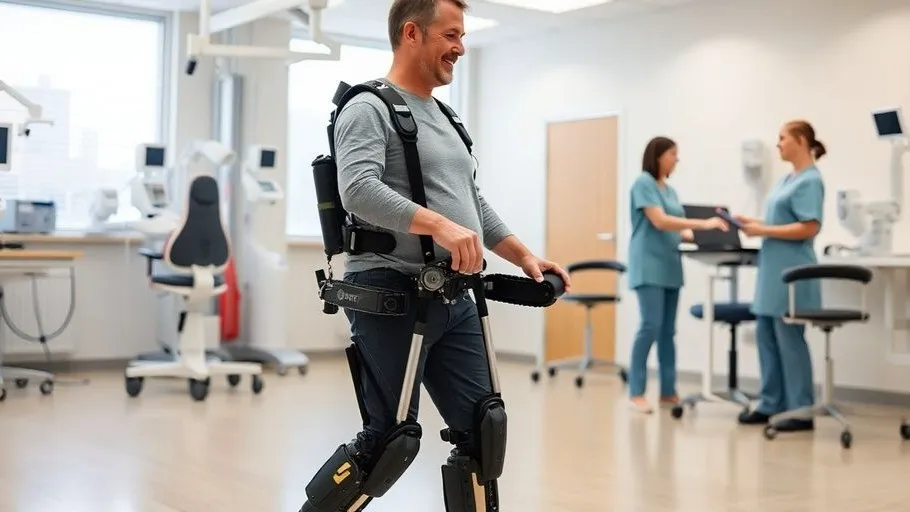
When Dan Richards entered the sea for a New Year’s Eve swim in 2023, he could not have imagined that the moment would redefine the course of his life and later place him at the centre of a growing business and technology conversation. A sudden wave flipped him unexpectedly, driving his body into the sand at Langland Bay near Swansea and causing a severe neck injury that left him instantly paralysed.
“I knew immediately that something was wrong,” Richards recalled later. At just 37 years old, he was unable to move his body, marking the start of a long and uncertain journey through trauma, rehabilitation, and medical innovation.
From Devastating Diagnosis to Determined Recovery
In the days following the accident, doctors delivered a grim assessment. Richards was told he would likely remain bed bound for the rest of his life, with little expectation of regaining movement. Such diagnoses are not uncommon for spinal injuries of this severity, where damaged neural pathways limit communication between the brain and body.
For Richards, the prognosis was devastating but not final. Over the next two years, his recovery became an example of how emerging technologies are beginning to shift the boundaries of what is medically possible. While he now uses a wheelchair, he has regained movement in his arms and fingers, progress once considered highly unlikely.
Artificial Intelligence Moves From Research to Real Life
A key part of Richards’ progress has come through the use of artificial intelligence driven rehabilitation tools. These systems analyze muscle signals, nerve responses, and movement patterns in real time, helping therapists tailor recovery programs with unprecedented precision. Instead of relying solely on static routines, AI adapts exercises based on how the body responds, accelerating learning and neural rewiring.
From a business perspective, this case reflects a broader transformation in healthcare technology. AI powered rehabilitation platforms are attracting investment from medical device firms, insurers, and health startups seeking scalable solutions for long term care. As populations age and spinal injuries remain costly to manage, intelligent rehabilitation tools are increasingly viewed as both a clinical and commercial breakthrough.
The Business Case for AI Assisted Mobility
The global rehabilitation technology market is expanding rapidly, with AI playing a central role in its evolution. Tools that help paralysed patients regain movement reduce long term care costs, shorten hospital stays, and improve independence. For healthcare systems under financial pressure, these efficiencies are significant.
Companies developing AI assisted mobility devices are now positioning their products not just as medical aids, but as productivity enhancers that allow patients to return to work, social life, and economic participation. Richards’ progress illustrates this shift. His regained arm and finger movement has restored a degree of independence that once seemed impossible, changing his relationship with work and daily life.
Human Resilience Meets Technological Momentum
While technology has played a crucial role, Richards emphasizes that recovery is also deeply human. Mental resilience, consistent therapy, and support networks remain essential. AI, in this sense, acts as an amplifier rather than a replacement for human effort.
This balance between human determination and machine intelligence is shaping the future of rehabilitation businesses. Successful models combine clinical expertise with data driven systems, creating outcomes that are both measurable and meaningful.
A Glimpse Into the Future of Recovery
Richards’ story represents more than personal triumph. It highlights a growing sector where health innovation intersects with long term economic value. As AI continues to evolve, similar recovery pathways may become standard rather than exceptional.
Two years after being told he would never leave his bed, Richards’ progress signals a powerful message for patients, clinicians, and investors alike. Artificial intelligence is no longer confined to labs and forecasts. It is actively reshaping lives, industries, and the business of recovery.