Business
US Bond Investors Position for Mild Fed Easing, Favour Intermediate Treasuries

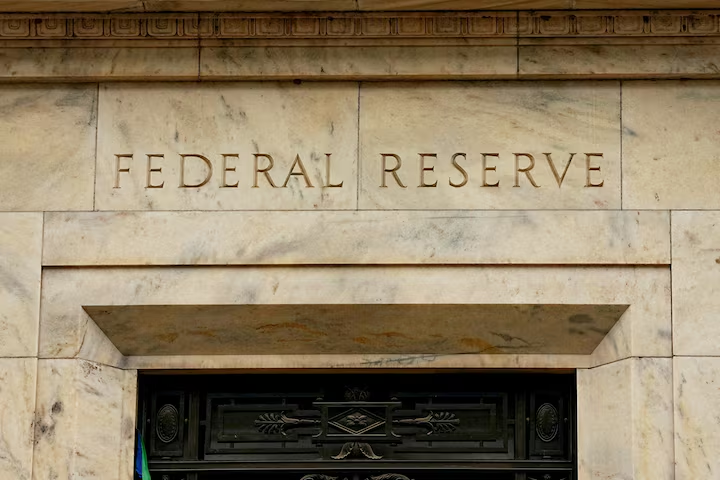
US bond investors are adjusting their strategies ahead of the Federal Reserve’s final policy meeting of twenty twenty five, signalling a growing belief that the central bank will move cautiously when it begins to cut interest rates. Rather than preparing for an aggressive easing cycle, market participants are anticipating only mild and gradual reductions, prompting them to shift away from long duration Treasuries. This repositioning shows how expectations of limited policy changes are influencing the structure of the bond market and shaping investment choices across the yield curve.
Rotation Toward the Middle of the Curve
With rate cuts expected to be modest, investors are rotating into intermediate maturities, where yields remain attractive without the heightened interest rate risk associated with long term bonds. Intermediate Treasuries, typically spanning three to seven years, have become the preferred choice for those seeking what analysts describe as juicier returns in a period where the Fed’s policy outlook is constrained. This part of the curve offers a balance between capturing income and avoiding the volatility that can come with holding ten year or thirty year maturities when monetary policy expectations are uncertain.
Fewer Rate Cuts Expected in 2026
Adding to this cautious positioning is the fact that many major Wall Street banks have revised their projections for twenty twenty six. Persistent inflation concerns and confidence in the resilience of the US economy have prompted analysts to forecast fewer rate cuts next year. Although inflation has eased from its peak, it remains elevated in certain sectors, making policymakers wary of cutting rates too quickly. A strong labour market and steady consumer spending have reinforced the view that the economy may not need significant monetary stimulus. As a result, traders are positioning for a scenario where interest rate reductions occur more slowly and in smaller increments.
Why Investors Are Avoiding Long Duration Bonds
Longer dated Treasuries are typically more sensitive to changes in interest rate expectations. If the Fed signals fewer cuts or extends the timeline for easing, yields on long term bonds may rise, causing prices to fall. This potential for capital losses makes many investors hesitant to commit to long duration assets at a time when the Fed’s strategy is still evolving. By contrast, intermediate bonds offer a more stable risk reward profile. They allow investors to benefit from current yields while limiting exposure to the uncertainty of long term rate movements.
Market Sentiment Reflects a More Balanced Economic Outlook
The cautious stance among bond investors also reflects a broader shift in sentiment. While fears of recession have faded, the possibility of inflation remaining sticky has grown. This has created a mixed environment where neither aggressive tightening nor significant easing appears likely. Instead, market participants expect the Fed to maintain a delicate balance, supporting growth without reigniting inflationary pressures. For investors, this means positioning for stability rather than dramatic monetary shifts.
What to Watch as the Fed Delivers Its Final Decision of the Year
As the Federal Reserve prepares to announce its final policy decision of twenty twenty five, the bond market’s behaviour offers a clear signal of expectations. Any hint from the Fed about the pace and scale of future rate cuts will have immediate implications for the yield curve. A more dovish stance could revive interest in longer maturities, while a cautious or divided message may reinforce the current tilt toward intermediate bonds. In either case, investors are preparing for a landscape defined by modest easing and steady economic performance.