News
Israel Faces Growing Political Crisis Over Ultra-Orthodox Army Conscription

Israel is heading toward a major political showdown as lawmakers debate whether to end long-standing military draft exemptions for ultra-Orthodox men. The dispute is rapidly becoming one of the most divisive issues confronting Prime Minister Benjamin Netanyahu, threatening to fracture both his governing coalition and Israeli society.
For decades, ultra-Orthodox, or Haredi, men enrolled in full-time religious study have been exempt from compulsory military service, a policy established when Israel was founded in 1948. Nearly twenty years ago, Israel’s High Court of Justice ruled the exemption illegal, but successive governments continued it through temporary arrangements. Those arrangements expired last year, leaving the government legally obligated to begin drafting members of the community.
According to testimony presented to lawmakers, around twenty-four thousand draft notices were issued in the past year, yet only about twelve hundred ultra-Orthodox men reported for service. The low compliance rate has fueled growing frustration, especially after two years of war in which reservists and active duty soldiers have shouldered heavy burdens.
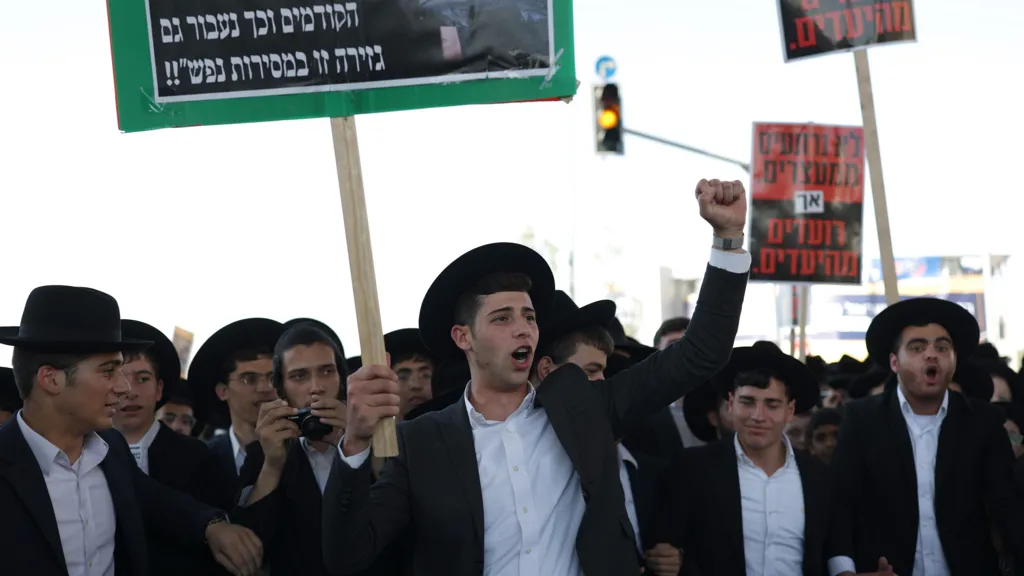
Public debate over the exemption has intensified, spilling into heated street protests. Lawmakers are now considering a new bill that would require ultra-Orthodox men to serve alongside other Israeli Jews. The proposal has triggered strong backlash from parts of the Haredi community. Two ultra-Orthodox politicians were recently targeted by extreme protesters, and a Border Police unit had to rescue Military Police officers confronted by a large crowd while attempting to arrest a suspected draft evader.
These confrontations have given rise to a new alert system known as “Black Alert,” allowing community members to quickly mobilize protests when arrests are attempted. Last month, tens of thousands of Haredi men demonstrated in Jerusalem, reflecting not only anxiety over conscription but also a deeper struggle over the nature of the Jewish state and the role of religion within it.
Supporters of maintaining the exemption say religious study is a vital form of national service. At the Kisse Rahamim yeshiva in Bnei Brak, head of school Rabbi Tzemach Mazuz said Torah study is essential to Israel’s protection. “By studying Torah, we protect the soldiers wherever they are,” he said, describing the seminary as “our army.” He acknowledged, however, that attitudes in Israel are shifting and that political leaders are less willing to uphold religious privileges.
Rabbi Mazuz rejected criticism that yeshiva students are avoiding responsibility, arguing that many in secular cities, including Tel Aviv, evade conscription as well. But military data shows Tel Aviv contributed some of the highest enlistment numbers during the war, intensifying scrutiny of those who do not serve.
With the government under pressure to enforce the law and the ultra-Orthodox leadership refusing to compromise, the conscription issue is shaping up to be one of the most explosive political challenges in Israel today. Whether lawmakers can find a solution acceptable to both religious and secular communities remains uncertain.