
Tech
Indian scientists spot a Milky Way like galaxy from 12 billion years ago

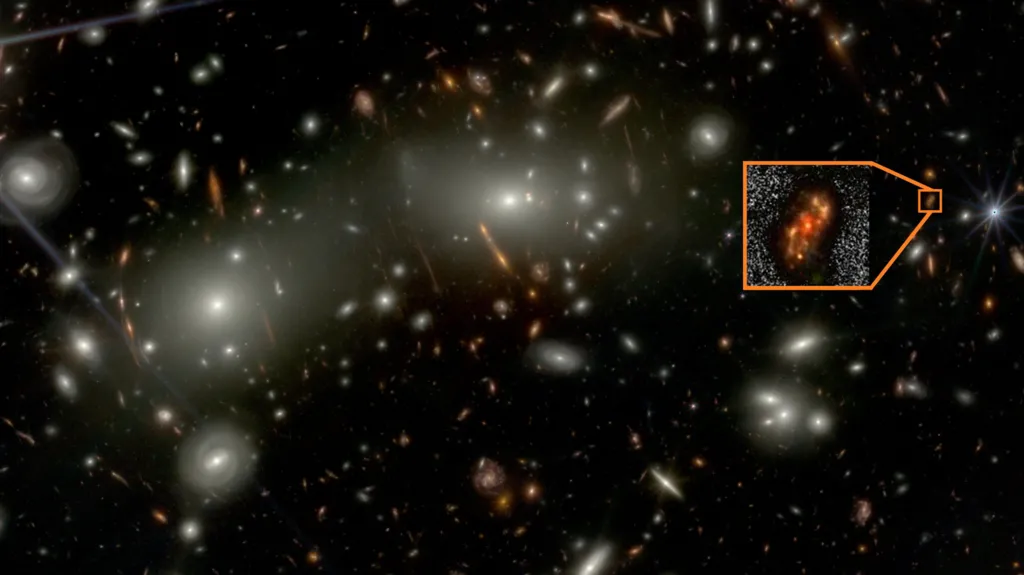
Astronomers in India have identified a galaxy so distant that its light has taken roughly 12 billion years to reach Earth, offering a rare window into the early history of the Universe. The discovery, confirmed through observations from the James Webb Space Telescope, has left researchers both excited and puzzled. In London’s scientific circles, where breakthroughs in cosmology regularly spark curiosity, this finding is already drawing attention for the questions it raises about how our cosmos formed.
The galaxy, nicknamed Alaknanda by the research team, dates back to a time when the Universe was only 1.5 billion years old. If the age of the Universe is estimated at 13.8 billion years, this means scientists are essentially looking back at an era when cosmic structures were still in their infancy. What makes the discovery remarkable is not simply its age, but its form. Early galaxies are usually irregular and unstable, shaped by turbulence and frequent collisions. Yet Alaknanda appears to be a fully structured spiral galaxy, not unlike our own Milky Way.
That level of order so early in the Universe’s timeline is rare. Lead researchers Rashi Jain and Yogesh Wadadekar used the powerful vision of the JWST to study the galaxy. Its light was magnified by the gravitational lensing effect of the Abell 2744 galaxy cluster, a massive grouping of galaxies that bends light around it. This natural magnification made the faint distant spiral easier to spot and analyse. Even with that assistance, the galaxy would have remained invisible to older telescopes.
The spiral form suggests that stars, dust and gas in Alaknanda had already organised into a stable rotating system at a time when such order was not expected. Many astronomers believed spiral structures took billions of years to emerge through slow accumulation and regulated star formation. This newly observed galaxy challenges that view, implying that some galaxies may have reached maturity far earlier than models predict.
In London’s academic community, astrophysicists say Alaknanda could become a key case study, prompting a reassessment of how quickly galaxies can take shape. Researchers at major institutions, including the capital’s cosmology groups, have noted that the discovery adds to a growing list of early well-formed galaxies spotted by JWST. Each one pushes scientists to refine or rethink long standing theories about the speed and sequence of galactic evolution.
The James Webb Telescope has already transformed our view of the distant Universe, revealing objects that appear too bright, too massive or too developed for their eras. Alaknanda now joins that intriguing collection. The presence of a clear spiral structure suggests that gravitational dynamics and star formation processes were more efficient in the early cosmos than once assumed.
For the Indian team, the discovery marks a milestone. Using one of the world’s most advanced observatories to identify a galaxy from the Universe’s early chapters underscores the growing role of Indian astronomers in global space research. The hope among the researchers is that further analysis will tell them more about how Alaknanda formed so quickly and what conditions shaped its elegant structure.
As London scientists continue to follow the findings, the larger question remains. If galaxies like Alaknanda existed so early, how many more could be waiting to be discovered, hidden in the deep background of space and time.



