Business
How a Florist Became a Drone Maker and How the Weapon Went Mainstream

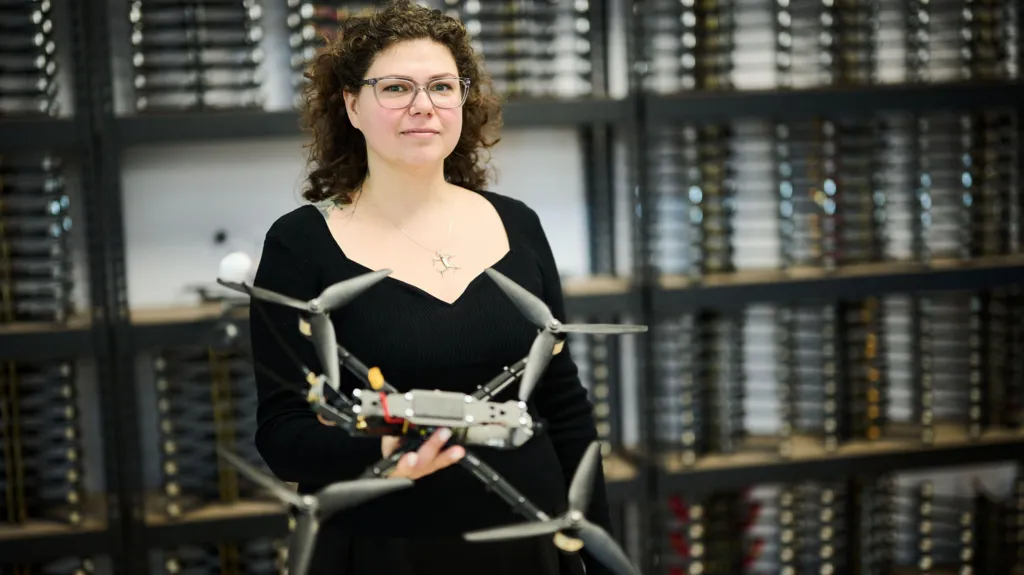
The war in Ukraine has changed many lives, but few stories capture this transformation as vividly as that of Kseniia Kalmus. Before the Russian invasion, she spent her days arranging flowers, managing a shop in Kyiv and travelling around Europe to display her floral art. Her world was filled with colour, creativity and the delicate calm of her craft. Today, that same woman builds drones for the front lines. For her, the shift was not only dramatic but driven by a sense of duty that became impossible to ignore.
Speaking from Kyiv, she explains that the decision felt immediate. The moment the war began in February 2022, she wanted to do something meaningful for her country. At first, she raised money for whatever soldiers asked for, whether vehicles, uniforms or medical supplies. As the war evolved, so did the requests coming from the battlefield. More and more, she was hearing one specific need. Frontline units urgently wanted FPV drones. This demand reshaped her volunteer work, and eventually her entire life. She learned how to source parts, assemble the drones, and organise small production teams. Today, she and other volunteers build hundreds of drones each month. These small quadcopters, similar to those used at weddings or family events, become lethal weapons once equipped with explosives.
The Drone as the Modern Face of Warfare
Ukraine’s conflict has introduced the world to a new era of fighting. From small hand operated drones to long range unmanned aircraft, drones have become a defining feature of modern warfare. They are used for surveillance, delivery, and direct attack, and they operate across land, air and even underwater. Their impact has changed military thinking everywhere, from generals to engineers to the volunteers working quietly in their homes.
Before the invasion, only a few Ukrainian companies produced drones. Today, there are hundreds. The government says that roughly three-quarters of Russia’s battlefield losses are now caused by drones, not artillery or bullets. That figure shows how central these devices have become. They are inexpensive, easy to assemble, and surprisingly effective. This has turned Ukraine into what many call the world’s first true drone battlefield.
Experts like Stacie Pettyjohn, director of the defence programme at the Center for a New American Security, say the transformation is historic. She describes countless small operations across Ukraine where people build drones in garages, apartments and makeshift workshops. She says these community efforts have turned drones into the primary weapon of choice for the Ukrainian military. Their influence is not limited to Ukraine. Conflicts in Myanmar, Sudan and the Middle East have also seen a rapid rise in drone warfare. Even European states have started planning drone defences and what some call drone walls to protect their borders.
Global Expansion of a Powerful New Industry
The rise of drone warfare has attracted major global companies. The world’s biggest defence manufacturers, including Lockheed Martin and Boeing, are investing heavily. Smaller but specialised firms have also grown rapidly. AeroVironment, a US listed company, has seen its share price rise more than four times since the start of the full scale invasion.
In Europe, Portugal’s Tekever reached unicorn status with a valuation above one billion dollars, while Germany’s Stark is expanding production with a new factory opening in Swindon in England. The UK government has also committed billions to developing more advanced drones for future military use.
Mike Armstrong, who oversees Stark’s operations in the UK, says drones have reshaped the entire defence landscape. He believes traditional systems like tanks and large artillery still matter but drone technology has become the most significant innovation in modern combat. Its influence is expected to grow further as new designs, tactics and technologies appear.
The Rise of the Counter Drone Industry
Where there are drones, there are also efforts to stop them. As drones become more accessible and widely used, the need to counter them has grown just as quickly. A whole industry now focuses on detecting, jamming and disabling hostile drones. This is not limited to battlefields. Airports, power stations and government buildings around the world have become targets for drone disruptions. Belgium recently closed Brussels Airport temporarily after suspicious drone activity, prompting an urgent search for new protective systems.
One company riding this wave is DroneShield, an Australian firm producing advanced counter drone technology. Its chief executive, Oleg Vornik, explains that their equipment can be carried by hand, mounted on vehicles or placed around military bases to identify and neutralise drones safely. DroneShield’s stock price has soared fifteen times since 2022, highlighting the growing demand for these systems. The company now supplies not only Ukraine but also countries in the Asia Pacific that worry about surveillance by foreign drones. Colombia and Mexico also rely on DroneShield to protect facilities targeted by criminal groups using drones.
The future of warfare is being shaped in real time, and drones sit at the centre of this transformation. What began as a consumer technology has become an essential military tool, reshaping industries, economies and the lives of ordinary people like Kseniia Kalmus.