News
‘First Aid for Manuscripts’: Early Recovery Work Begins at Gaza’s Damaged Heritage Sites

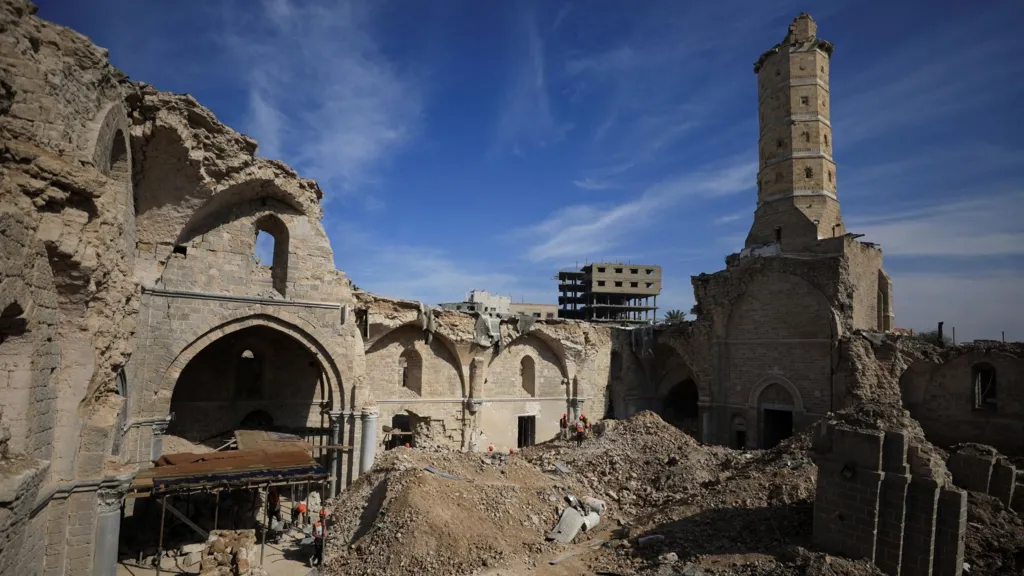
In the heart of Gaza City, teams of Palestinian workers wearing hard hats and bright safety vests are slowly clearing rubble from the ruins of the Great Omari Mosque, the Strip’s oldest and largest place of worship. The medieval mosque, known for its distinctive octagonal minaret, now stands in fragments. After two years of war, only pieces of the outer walls and the broken base of the minaret remain, following Israeli military strikes during the fighting with Hamas.
With a US-brokered ceasefire holding for nearly eight weeks, cultural workers and engineers have begun the painstaking process of sorting stones and debris. But full restoration is still beyond reach. Israel continues to restrict the entry of building materials into Gaza under the terms of the truce, preventing reconstruction work from beginning.
Engineer Hosni al Mazloum from Riwaq, a Palestinian heritage organisation, says his team is facing enormous obstacles. There is a critical shortage of materials like iron and cement, and workers are forced to rely on simple tools such as pickaxes and wheelbarrows. The work requires extreme caution, he adds, because many of the stones date back more than a millennium.
A short distance away, the restoration effort looks very different. In a small office in Gaza City, conservationist Hanin al Amsi is carefully piecing together fragments of rare Islamic manuscripts recovered from the mosque’s thirteenth century library. Speaking over video link, she compares her work to medical care. “Just like we give first aid to people, we are giving first aid to manuscripts,” she says.
Al Amsi explains that at the beginning of the war a young colleague risked his life to rescue some manuscripts while the Old City was under heavy Israeli bombardment. Many other works, however, remained trapped under the rubble. When a two month ceasefire began in January, her team, supported by funding from the British Council, began retrieving what they could by hand.
Despite what she calls catastrophic losses, she has found unexpected hope. Of the 228 manuscripts held in the library, 148 have survived. She credits the pre war preservation work she carried out in partnership with the British Library, which included storing the manuscripts in acid free boxes and securing them in iron safes.
She lifts a box to the camera, showing scraps of burned paper covered in Arabic calligraphy. Some items have emerged almost untouched, she says, while others are so damaged they look “as if a child had torn them to pieces.”
In the past week her team has been able to use heavy machinery to uncover more parts of the collection, but the news is grim. The library’s archive, which included Ottoman era records and other priceless documentation of Palestinian history, has been completely burned.
As workers continue clearing debris at the mosque and conservators painstakingly stabilise fragile manuscripts, both efforts reflect a shared goal: salvaging Gaza’s cultural memory before it is lost forever.