Latest News
London Campaigners Urge Government to Withdraw New Floating Bus Stop Guidance Over Safety Fears

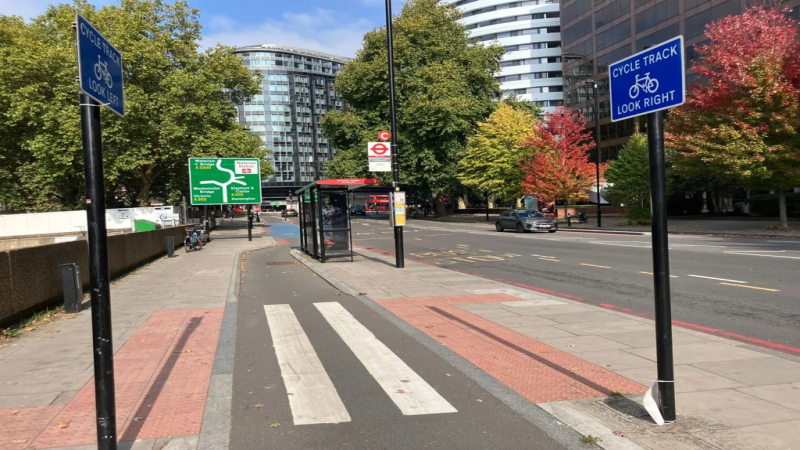
Campaigners are calling for newly published government guidance on floating bus stops to be withdrawn, arguing it fails to protect blind and visually impaired passengers and risks making streets more dangerous. Floating bus stops place a cycle lane between the pavement and the bus boarding area, allowing cyclists to continue moving while passengers get on and off buses. Critics say the updated guidance does little to address long standing accessibility concerns and repeats design approaches that have already drawn widespread opposition. Disability groups argue the document ignores the lived experience of people with sight loss and underestimates the difficulty of crossing active cycle lanes. They say the guidance appears to repackage existing schemes rather than confront the core safety issues. The row has reignited debate over how London balances the push for active travel with the need to ensure public transport remains accessible to everyone, particularly as similar designs continue to appear on borough managed roads.
The updated guidance follows a pause announced late last year on certain types of floating bus stops where passengers step directly into cycle lanes. While one design has been paused, other versions remain permitted, including bus stop bypasses where the cycle track runs behind the stop or shelter. Campaigners say this distinction offers little reassurance, as the fundamental risk remains unchanged for people with limited vision. Research suggests a significant proportion of blind and partially sighted people actively avoid these layouts because they feel unsafe and confusing. Advocacy groups argue there is still no clear and consistent method that allows passengers to cross cycle lanes independently and with confidence. They also question how consultation was carried out, claiming that concerns raised previously were either overlooked or inadequately addressed in the final guidance.
Transport authorities say floating bus stops are intended to reduce conflicts between buses and cyclists and point to collision data suggesting relatively low numbers of incidents involving pedestrians. They argue that improving cycling infrastructure is essential for road safety and congestion, and that guidance is designed to help local authorities find balanced solutions. However, critics say headline statistics fail to capture near misses, anxiety and reduced mobility for vulnerable users. The issue has taken on greater significance in London, where more than a hundred floating bus stops are already in place and more are planned. With boroughs, transport bodies and campaigners pulling in different directions, pressure is growing on ministers to revisit the guidance and provide clearer, enforceable standards that prioritise accessibility alongside cycling and bus travel.